Hello
I am here
I think
Most nights
Around the corner
On the stairwell
Down the hall
I am here
Yes
I get lots of visitors

Hello
I am here
I think
Most nights
Around the corner
On the stairwell
Down the hall
I am here
Yes
I get lots of visitors
*If you didn’t catch the start of this limited series, check out this post: October Stories #1. If you did and you’re back for more, welcome back, and thank you!*
A few years ago, I had a weird dream. This happens frequently, but my dreams usually aren’t vivid enough to warrant writing them down. This dream was different, and it inspired me to start the story I’m sharing today. I think about this one from time to time, but I’ve never come back to it. Maybe one day.
Anyway, enjoy! And come back next week. 😉
************
To anyone else, the door at the end of the hallway was just that – a door. And not a very interesting one. It was regularly tall, wooden, with panels in the standard places, and a simple brass doorknob. No light peeked out from underneath it, and the usual person looking at it would think, quite reasonably, that it opened to a narrow set of stairs leading up to a dusty old attic filled with boxes and crates brimming with the collected junk of a thousand yesterdays.
Sara Smith, however, and despite her entirely common name, was not a usual person. And her parents knew it.
All parents think their children are special. “Jack rides his tricycle faster than any other boy on the block,” a parent might say. “Yes, well, Jane is already writing in cursive and her fingers can barely fit around the pen,” another might reply.
Sara’s parents, sitting in the parlor with other families sharing lunch or tea, would change the subject. “The weather’s been lovely this summer,” they might suggest. Or sometimes, “I hear the spring festival this year is supposed to draw twice the normal crowd.” The conversation would then move on toward topics unrelated to children and their small but noteworthy accomplishments, at least for the next several minutes, and Bill and Anna Smith would look at each other and breathe two syncopated but inconspicuous sighs of relief.
Because Sara Smith was not a usual child.
Her birth was normal enough, if a bit early. She’d been a normally happy baby. She’d even liked prunes, though when her mother thought of that now, she wondered if it might have been the first sign that something was not quite usual. As Sara had grown, she’d hit her milestones right on schedule. She learned to babble and then to talk, to crawl and then to toddle and then to walk and then to run, to sound words and then to read them, and she’d even broken her arm trying to climb a tree when she was five. She liked unicorns, princesses, coloring books, and, much to her mother’s dismay, the color pink.
One night, when Sara was six and three months, and playing in the nursery her parents had set up in the bright, airy attic of their quaint, cozy house, her mother had come up to check on her. In between giggles, she’d heard Sara talking.
“My mommy says it’s good to be helpful and to share.”
Silence.
“I don’t know how, but I’ll try.”
Silence.
“You’re welcome. I like your necklace. It’s shiny.”
Silence.
“Sara,” her mother called, “who are you talking to?”
“The nice old lady,” Sara replied. “She wants me to help her.”
“With what?” Anna Smith was proud that her daughter was playing at helping.
“She says she’s not alive anymore and her son is sad and I should let him know that she’s okay and that the combination to the safe is seven seven three nine. That’s a really big number, isn’t it, Mommy?”
“Yes,” Anna replied, “it is.” She didn’t know what else to say.
Looking back, Bill and Anna Smith always thought of that moment as the one that changed everything, because it was the moment they knew that Sara, their happy, normal, freckled, giggly daughter, could see ghosts.

Sara Smith was not a usual child. And to anyone else, the door at the end of the hallway was just a door. But to Sara Smith, it was the entrance to her very special workshop.
In case you missed last week’s post, I talked about how my house sits along a mill race. The race is small and narrow, and if you didn’t know any better, you’d think it was only a creek. The mill, on the other hand, is a bit more…striking. Noticeable? Big. It is big.


You can’t miss it. Though you might not realize, if you’re just driving by, that it still operates today. It’s actually part of NOVA Parks, and you can take a tour, rent the space for events, and watch Mike the Miller at work. The mill also hosts historic reenactments and other educational events, as well as the occasional farm-to-table dinner.

Before we even moved into our house, when we were still under contract and stressing about it, I did a bit of reading on the mill. We’d driven by it several times, but we’d never taken an opportunity to learn more. What better way to distract myself, I thought, than to do some research. (I was an academic kid, and I never grew out of it.) I came across this article, which I won’t rehash but will encourage you to read, that tells the mill’s story: https://www.loudounhistory.org/history/aldie-mill/. It’s a good story. My favorite bit (if it gets you interested) has to do with Civil War soldiers hiding themselves in the wheat from John Mosby and his rangers. (See? You want to read about it now, don’t you?)
Anyway, I know I talk a lot about how lucky I feel to live in an area with such a long and rich history, and I probably sound like a broken record. But I think it’s important to understand that history is alive.
And this mill is a living piece of Loudoun County’s history.

I love a good ghost story. When people ask me if my house is haunted, I’m always just a little disappointed to say, “No, I don’t think so. Probably. Most of the time.”
Since it’s October, I’ve been thinking a lot about ghost stories. I actually think a lot about ghost stories a lot of the time. October just gives me a convenient excuse to let my weirdo flag fly. I think a lot of people think about ghost stories, because ghost stories are, at their hearts, human stories. Whether they’re psychological, tragic, uplifting, or frightening, ghost stories are fundamentally human. Most of us are curious about what will happen to us when we die, and ghost stories give us a tangible, palatable way to explore that curiosity.
I write a lot of ghost stories. Or, I should say, I start a lot of ghost stories. I seldom finish them. But I thought it would be kind of fun to share some of these abandoned pieces with you, for the month of October. Expect a post each week this month (four total), starting today, with what I thought might be the prologue to a ghostly murder mystery, inspired by my own longstanding (and admittedly strange) hobby of reading palms. A prologue is, so far, all it’s become. But I hope you enjoy it, fragment though it may be, and come back in the next few weeks for more.
*And a disclaimer – many of these are old, some of them are unedited, all of them are incomplete. Writing is messy work. But it sure is fun. And if you particularly like one of these, feel free to leave a comment! Maybe you’ll inspire me to get back to work on it. So with that in mind, into the ghostly ether we go!*
************
In my dream, I’m trying my best to ignore the sounds of someone crying in the room outside the kitchen. My mother is at the stove, worrying over the kettle, and I’m putting two tea bags into a chipped mug I got out of the sink. I take the mug over, and she pours the water and walks away, and then I’m alone and waiting to be allowed in my own living room again. Customers don’t like children, I’ve been told, and I can’t read yet anyway.
I know this is a dream because I know what happens next, but I never see it. Before the preacher slings the hot tea in my mother’s face for what she’s told him, before he slams the door and says we’re both damned to Hell, before my mother comes back into the kitchen to wipe her red, burned cheeks with a dirty dish towel, and before she tells me that a fortuneteller’s life is no life for anyone, I will wake up.
I’ll startle out of sleep and my hazy mind will muster whatever sense it has in the middle of the night to remember that my life is different, that I have built a better future, and that my mother has been dead for three years. I will remind myself that I haven’t read a single palm since the accident, and that it wasn’t my fault.
This I will tell myself over and over, “not my fault one, not my fault two,” counting my own reassurances the way that other people count sheep, until I fall back into an uncertain sleep and dream, again, of subtle lines in rough hands and the dangerous secrets they whisper to the few who can hear them. I will see my mother’s face, her wide green eyes sad and certain, resigned to the fate that I’ve read for her, my first and last paying customer. The lines will tell you everything, she reminds me, even if you’re not ready to listen. I’ll wake again and remind myself that I’m not listening. Not anymore. Not ever again.
This life might be no life for anyone, but I don’t know if it will ever let me go.

Back in 2016, when we were neck-deep in our search for a historic home and pretty stressed about it, I had a dream. I dreamed about an old farmhouse with a trail behind it. Just a quick dream. I woke up and didn’t think much about it. Searching for a home, especially a historic home, can be a grueling process, and I had lots of things on my mind, and weird dreams almost every night.
I also don’t normally put a lot of stock in dreams. But sometimes strange things happen.
See, in the woods behind my house, there’s a trail.
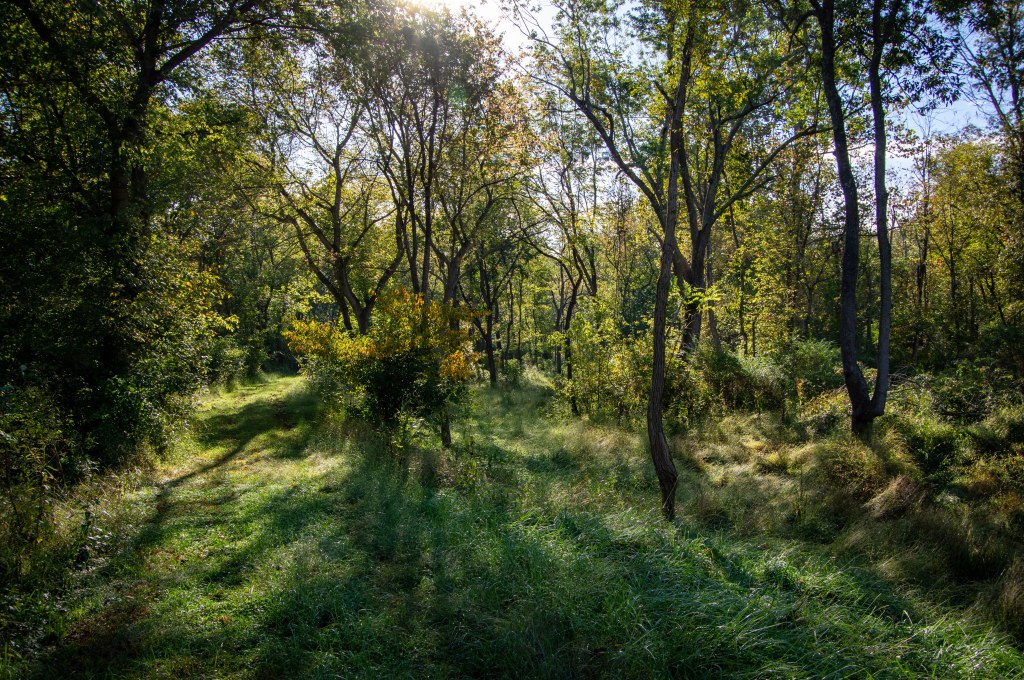
After we moved in, I asked some of our neighbors about it, and they called it “the mill race.” I didn’t know what that meant, though I knew we had a mill in town, and that the trail led about halfway to it. And then it occurred to me.
Beside the trail, there’s a little creek.
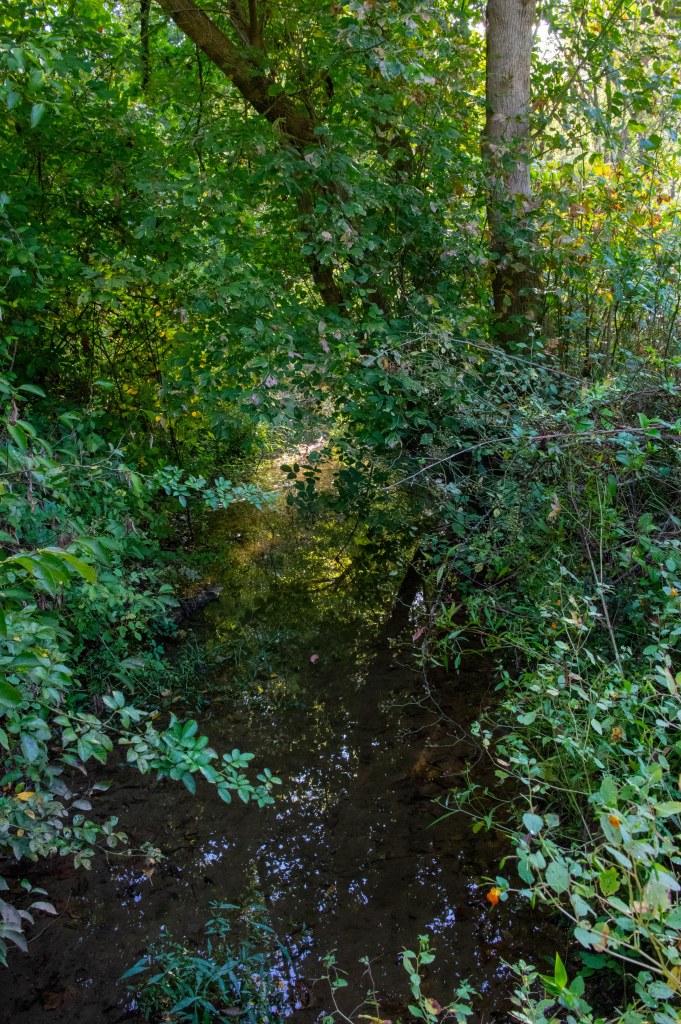
Or, at least, when we moved in, we thought it was only a creek. Turns out, it’s a race. And when neighbors told us about “the mill race,” they were talking about the creek, not the trail.
I did some digging and found this map, drawn by a noted local Loudoun County historian named Eugene Scheel.

So, as it turns out, we live along a head race. It starts at a small dam on the west end of the Village, and runs all the way to the mill on the east end.
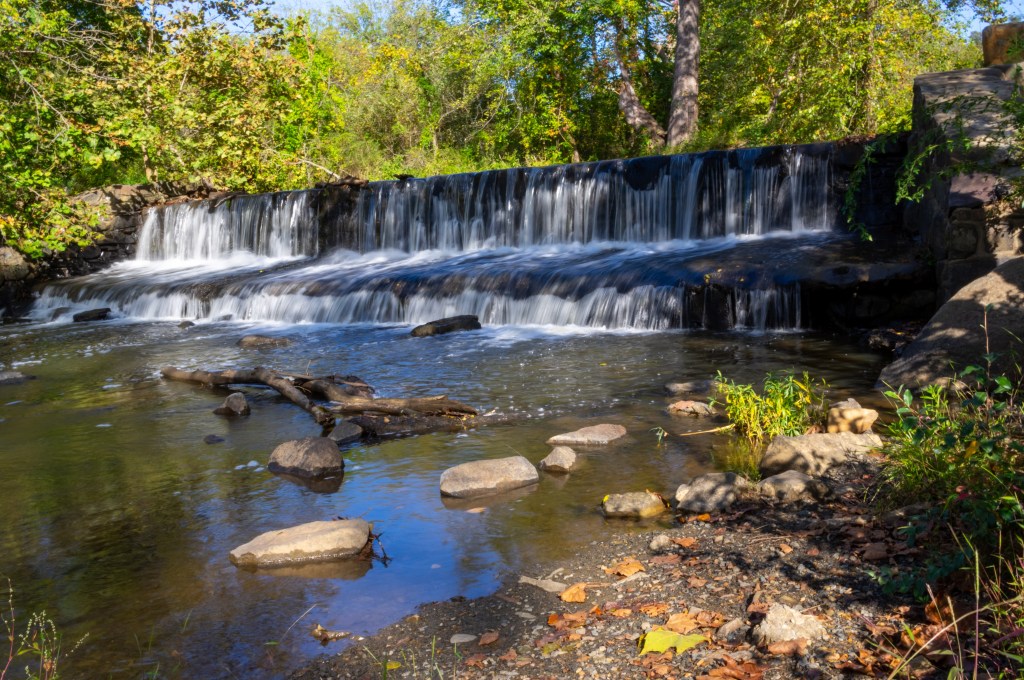
Pretty cool, right? I certainly think so. It’s another piece of history I get to experience every day.
Next week, I’ll write about the mill and share its story, so if you’re interested, be sure to check back on Friday, October 9th.
Until then, happy hunting, history adventurers!
I remember apple trees and shucking corn, and the smell of oil in a cast iron pan. A fine dust of white flour on the counter, and fried apple turnovers sprinkled with cinnamon and sugar at the center of a lace tablecloth.
I remember red and gold leaves, raked into thick pillars taller than me, and a woodpile at the bottom of the hill, stacked tight and high in advance of the coming cold.
And I remember my grandmother, her stubby, gnarled fingers, like knobby roots on an ancient tree, wrapped delicately around a tiny sewing needle. She made me a bright pink apron once, and I remember parading around the house in it, swooshing it around my hips like a ballgown.
There are things I don’t remember. I don’t remember the name of the family who lived down the hill, or the phone number I used to call to say hello to my grandmother after school. I don’t remember my grandmother’s face, though I recognize her in pictures, and I’d know her voice in a crowd even now. Some days, I don’t remember the names of my children and their children. Or so they tell me. And though I can play my favorite song on the piano, my own fingers now stiff and curved, I can’t remember the words.
Memories are precious things.
I used to spend whole days with my grandmother. We’d cook and talk, and she’d watch her gameshows. She’d tell me about when she was a girl, how she loved to read and play ball, how she was her class’s valedictorian, and how she always wished for a black-haired grandchild. My own hair was auburn. What’s left of it now whisps around my head in spindly gray spider’s webs.
One September day, just after the leaves had started to turn, my grandmother sat with me on her front porch. The air was still warm, but the breeze carried with it the bitter cold sting of winter. I must have been about seven. My grandmother had made us root beer floats and we were rocking back and forth in old wooden chairs, keeping rhythm with each other.
“How old are you,” I asked.
“Seventy-five,” she said. “I’m an old lady.”
“You’re not that old,” I answered. “Seventy-five isn’t that much more than fifty.”
“Well, then, I’m just over middle-aged,” she said, and laughed. She had a crackly, dry sort of laugh.
“Yeah,” I nodded, and dug my spoon so deep in my glass that root beer sloshed over the top and into my lap.
I can’t remember if the rocking chairs were painted red or white. I don’t know what happened to them after my parents sold the house. Maybe they’re still out there somewhere, rocking another grandmother and grandchild.
My grandmother died when I was twenty, and I have many more years behind me now. Time makes blank slates of all of us, slowly and meticulously, and unrelenting. Soon, like my grandmother, I will be a name in the family tree, a face in an old picture, a story or two at a holiday gathering, and people will argue over the details.
After I got lost driving myself to the grocery store one morning over the summer, my children hired a nurse to live with me, Heather, and she tells me not to worry about things like time. She says that I am strong for someone my age. She’s young, and once when I asked her, she told me she still remembers the name of her kindergarten teacher. I couldn’t remember something like that, even before I started losing pieces of my own story.
It’s September now, late in the month and early in the fall, and the leaves have just started to turn. I ask Heather every day to help me outside, where I can sit on my own front porch and watch as the wind blows them down.

Today, she’s spread a fleece blanket over my legs and she’s sitting beside me, reading aloud from my favorite book, Jacob Have I Loved. I can’t remember who wrote it.
“Heather,” I say, interrupting her just as they’ve discovered the sister can sing, “have you ever shucked corn?”
She folds the book up in her lap and says, “I don’t think I have. You can buy it from the store already ready to cook.”
I ask her if she can go to the store later and buy some corn that hasn’t been shucked. She says yes and goes back to reading.
Twenty minutes later, she leads me to my bedroom and I drift off to sleep. I dream of corn on the cob and of root beer floats.
************
My grandmother taught me how to pull corn off the stalk and shuck it. She taught me how to string beans and how to fry chicken and make biscuits so well that they came out golden and flaky every time.
Sometimes we’d make a batch of biscuits for no reason at all, and we’d eat them toasted and slathered with a thick smear of dripping yellow butter. This she bought from the store. I remember her telling me how to make homemade butter, once, but I can’t remember what she said to do.
I sent poor Heather to the store this afternoon with a grocery list a whole page long, but she didn’t seem to mind. She seemed happy, in fact. Maybe she’s relieved I finally want to do something besides stare out at the garden.
We’re in the kitchen together now, and I’m instructing her on how to mix the biscuit dough just right and how you need to salt each piece of chicken individually before you cover it in flour and crushed up Corn Flakes to fry it. I’m too weak to stand long enough to do it myself, and she’s being a good sport.
“We’re going to have a feast,” she says. She’s got flour on her chin and smudged just under her eye.
“This was just a normal dinner when I was little,” I say. “You should have seen what we used to put on the table every night.”
“You’ll have to teach me more,” she says, and I nod.
“I never could get red velvet cake right,” I answer. “We could try that sometime.”
“I’d like that,” she says.
She comes over to sit by me at the table, and she brings with her a package of four ears of corn, all still in their husks.
“Now,” she says, “you tell me what to do, and I’ll just follow your directions.”
I tell her the best I can, miming everything and probably looking silly, but she doesn’t laugh. She gets to work. Her long, slender fingers are quick and she makes the whole thing look easy.
“One day, you’ll teach someone how to do this,” I say. “You can tell them you learned from the second best.”
“I can tell them I learned from the best,” she says. “I’ve never met anyone better.”
She finishes cooking everything and we sit down to eat together. She tells me little things about her life, and I smile and nod and try my best to bite down and grab the corn off the cob with my teeth. Eventually, she cuts it off for me and I eat it with my fork. It’s such a small thing, but it’s one more. One more thing I’ve lost. I can’t remember the last time I could eat corn right off the cob. It was kind of her to let me try.
After dinner, Heather helps me to bed and sits down beside me once I’m settled under the covers.
“Thank you for sharing all those recipes with me,” she says.
I roll over on my side and close my eyes. She reads for a bit, her gentle, even voice almost a song.
************
I remember nights without street lights, with stars as bright as flame and a big, yellow harvest moon in the sky. I remember the bitter smell of wood fire, burning hot and steady in the old metal stove downstairs. I remember evenings spent playing Rook and drinking cold boiled custard.
I remember the rustle of the wind through the leaves and the stiff cornstalks in my grandmother’s garden. I remember her dented black mailbox, at the top of the hill. I don’t remember the address, but I remember the long walks up and down, my grandmother beside me, beckoning me to keep up with her. I remember complaining that it shouldn’t be so hard to get your mail.
Tomorrow I will ask Heather to pick up some green apples. We’ll make fried turnovers, and I’ll tell her how I learned to peel apples without a fancy peeler, and how my grandmother used to make jars and jars of apple butter and keep them on shelves in her basement, ready for visitors who wanted a little something sweet.
I will tell her these things, while I can still remember them. Maybe I’ll even ask her to write them down. And maybe someday someone will find them, and I will become a new memory.
Moving off of my property for this post, but only just, and I promise a good story. About five minutes from my house, there’s a church and cemetery.

Mt. Zion Old School Baptist Church was the site of a Civil War skirmish, a hospital, and a barracks (among other things). Graffiti dots its walls, tangible remnants of the soldiers who recovered within them. Its congregation met until 1980, and it is now a public park offering educational events, tours, and event rental space. The adjoining cemetery contains both marked graves – including one War of 1812 veteran – and at least 64 unmarked African American graves that lie outside of the cemetery’s gray stone walls. It sits along a historic roadbed, at a crossroads that was, once upon a time, essential to travel in Loudoun County.
There aren’t many places in the area that have seen quite as much history as Mt. Zion, and, when I first visited, I was intrigued to find that it’s even considered a Historic Site in Journalism. (I didn’t know such a thing existed, and am happy to have that knowledge, now.)

The text on the plaque reads:
In the graveyard adjoining this church, on June 23, 1863, Harpers Illustrated Weekly’s Alfred A. Waud, one of the Civil War’s most renowned artists, dug the grave for the burial of his friend, Lynde Walter Buckingham, the chief cavalry correspondent for the New York Herald.
Buckingham had spent the day of June 21 covering what would become one of the largest cavalry battles in U.S. history, in and around the villages of Aldie, Middleburg and Upperville. At the front with Union General Judson Kilpatrick throughout the June 21 fight, Buckingham was on his way to Washington with his account of the fighting when Confederate Partisan fighters under Major John Singleton Mosby’s command overtook him and caused his horse to dash down a steep hill and throw its rider powerfully to the ground. Buckingham later died of injuries to his skull in a makeshift Union Army hospital within this church.
After burying his friend, Waud rode on to Gettysburg, where on July 2 and 3 he sketched scenes of the fighting there that continue to shape Americans’ views of that epic battle. A couple of days after Buckingham’s burial, Union Captain Webster, an old friend of his, came to Mt. Zion with an escort and ambulance to disinter the body and send the remains to Buckingham’s family.
The Society of Professional Journalists hereby designates Mt. Zion Old School Baptist Church and Graveyard a Historic Site in Journalism. For as long as they exist, they will recall the devotion to duty and fellow man that embody the best qualities of America’s war correspondents.
Marked this 14th day of June, 2013.
It’s a sad story, isn’t it? And a tragic memory worth preserving. But there’s life and community at Mt. Zion these days, as the curious passerby and the avid history buff alike drop in to look around and learn, and to enjoy the beautiful rural viewshed ideal for an afternoon picnic.
I’m sure Mt. Zion has many, many stories left to tell.

The short answer is: It is not.
I read this book recently, which gives brief descriptions of the routines of famous writers, artists, and other creatives.

I’d recommend it, if you’re looking for a fun, quick read. And it did get me thinking.
When I decided to pursue writing as more than just a hobby, I thought I’d develop a routine and habits, in the same way I’d developed them working in an office – a 9:00 a.m. coffee, a quick walking break mid-day, a late afternoon rush of productivity. But that never happened. I do write a fair amount, most weeks, but never on any kind of schedule, and never as part of a regular practice. And when people ask what my routine is, I never really know what to say.
“Well, while still in last night’s pajamas, I sit in the recliner in my living room and I drink coffee until I’m jittery, and then I type frantically on my laptop until something happens. And then I keep at it until it’s done, which is sort of indeterminate and looks different every day, but I really can’t focus on anything else until I hit some kind of stopping point and please don’t ask me to. And then it’s usually time to eat something or at least drink water because I’ve forgotten to do that all day.”
Like, is that a routine? That doesn’t seem like a routine. But it works for me, at least most of the time.
Though I hate to be asked, I confess I do find it fascinating how different people approach the act of creating. I feel like it’s deeply personal to each creator, and that’s probably why it’s often hard to explain. Or, for some, why it’s easy.
I’ll start this one with a story.
When I was in third grade, my class had two pets – a cute, chubby red and white guinea pig, and two bright green praying mantises that I thought looked a lot like aliens. At the end of every week, two students were chosen, by popular vote of the class, to take the pets home and care for them until Monday. I desperately wanted to bring the guinea pig home for the weekend. But when my name finally came up and the class voted, I got…the praying mantises.
So there I was at the end of Friday, trundling down the steps off the school bus, saddled with my backpack, my spring windbreaker, the books that wouldn’t fit in my backpack, my lunch box, and a wire cage containing two potentially extraterrestrial life forms that I had absolutely no idea what to do with. When I opened the door and plopped the cage down on the kitchen table, my mother was predictably less than pleased.
“What is THAT?”
“Praying mantises.”
“Why do you have those?”
I explained what happened, and she told me I shouldn’t volunteer to take the class pets home ever again. Honestly, I don’t blame her.
Fast forward about thirty years, give or take, and my garden is positively brimming with brown praying mantises right now. It might be karma. But they’re actually kind of interesting to watch, so I’m not complaining.
We’ve been seeing them mostly on our windows at night, seeking out moths to snack on. Earlier this week, though, my husband looked out the window of his study and found this little guy hanging out in our euonymus.

He’s sort of cute, actually. And very photogenic.

And possibly has aspirations to conduct an orchestra?

Live your dream, buddy.
I don’t want him inside my house, would not even consider keeping him as a pet, but as an occasional visitor who keeps to himself, he’s perfectly welcome.
I love you because
when I want cider and you want wine,
we drink cider.
I love you because
you learned to cook
so you could do it with me,
and because you always give me the best spot on the couch.
I love you because we talk about the world
and where we want to go in it
and how we can make it a little better
together.
I love you because
you dance with me in the dining room
when we should be doing dishes
and because you know all the words to Bohemian Rhapsody.
I love you because
you exist and are, in the same way that
birds fly and
fish swim and
flowers bloom.
There will never be enough time for
how much I love you.
But seven years is a just fine start,
and for now will have to do.

 A Virginia Writer's Diary