Light and Shadow:
We are made of both,
and we choose how they balance.
Each moment a call –
to break or create,
arms or alms,
hate or a hand,
action or none.
This power is ours.
Light or shadow,
growth or fallow,
only we choose.
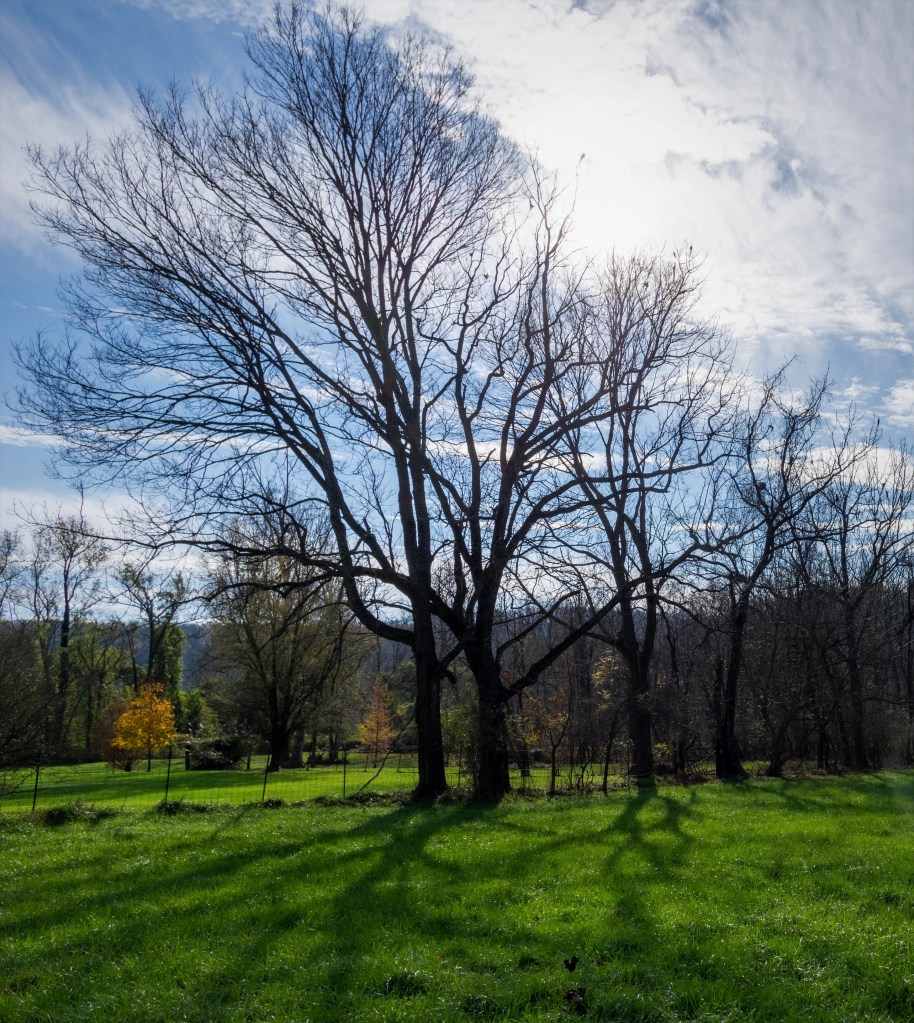
Light and Shadow:
We are made of both,
and we choose how they balance.
Each moment a call –
to break or create,
arms or alms,
hate or a hand,
action or none.
This power is ours.
Light or shadow,
growth or fallow,
only we choose.
Veteran’s Day always makes me think of my grandfather, my favorite veteran.

He died in 2015. He didn’t talk much about his service, at least not to me. What little I do know, I’ve learned from my mother, and I’m always trying to piece it together in stories, because those are all I have left of him now. I wonder how many grandchildren could say the same thing.
Here’s something I wrote not long after he died. I thought I might include it in a larger work (that still isn’t done, and might never be).
Some of it’s true.
************
At a fork in an old country road, surrounded by rocky fields and green mountains and flanked on both sides by cracked pavement, sits an old white farmhouse. Its shutters and clapboard are going grey, its chimney is crumbling, and any reminder that it used to be part of a functioning farm is long gone, replaced by overgrown patches of wild onions and cattails. There’s no sign now that it ever housed a family. This is the house where my grandfather grew up, nestled outside of a small Appalachian town.
The land is called Hell’s Half Acre, and my grandfather knew, when he was a boy, that he’d have to work it. Walking home from school, a satchel of books swinging in his hand, he wondered every day if it would be the last he’d make the trek. And one day it was. He left school in seventh grade, a servant to the farm. It was that, he told my mother, or be sold to another family, one with the resources to afford another mouth to feed. Instead, he used his hands to work. Evenings on the farm, and days underground, laying wood for mine shafts. And each day, he’d stare at the fork in the road, and wonder if he’d ever get to choose any direction at all.
“When I grow up,” he said to himself, eating dinner at a quiet table full of tired, hungry people, between gulps of buttermilk and bites of toasted biscuit, “when I grow up…” He didn’t dare dream of that time. Dreaming felt hopeless, not an escape but a trap, a long, dark tunnel with no light at the end.
Then, when he turned sixteen, there came a war.
“I’m going to sign up,” he said to his brother, and he did. He lied about his age, though not by much, and found himself on a train west, to basic training somewhere in the Dakotas. And then a ship east, to Africa. And then a ship north, to Italy. And it was there, sleeping in empty towns and eating blood-spackled bread, that he met a girl. Sort of.
Back home, my grandmother was reading books by flashlight every night, hiding under her covers from a father who thought women shouldn’t read and a step-mother who wore her dead mother’s clothes. Sometimes, in the quiet, heavy darkness, my grandmother would talk to her sister, who died when they were both very young, because she had no one else to talk to.
“Lucy,” she’d say, “when I grow up…” And she’d pause. “When I grow up…” And she couldn’t finish the thought. When she grew up, she would be some man’s wife, some child’s mother, and finally some graveyard’s newest coffin.
And then one day, she sent a picture and a letter to a soldier from the county, off fighting in a war that involved the whole world. And it changed everything.
The night we moved to Glenmoor Farm Estates, there was a windstorm. The biggest, loudest windstorm I’d ever heard. It shook the windows, rattled the plastic shutters against the siding, thrummed against the door frames and snapped and tore through the flimsy new-growth trees in our front yard. And it blew over the empty dirt field around us in gusts so ferocious and powerful it felt like a living thing. Like a monster, a giant come down from the sky to wreak havoc and eat humans and spread chaos and destruction in its terrible wake.
My dad tells me it was just a little wind, but I remember it differently.
I was ten when we moved in. I was “too old” to be afraid of silly things like wind and giants and the dark, but then, you’re never really too old to be afraid, are you? We’d been living in a row house close to the city. My little sister and I had shared one of the two tiny bedrooms, and when my parents found out that we would have a new baby brother or sister – it turned out to be both, and they’re too young to remember the move – they told us it was time for a bigger place. So off to the suburbs we went, the four of us soon to be the six of us, out into the wild, as far as I was concerned.
Our old neighborhood was tight, close, and full of other kids. We’d walk to the basketball court, or the pool, or just around on the sidewalk, and we’d bring frisbees and yo-yos and chalk and cards. We’d play and talk and hang out until dinner, or until it was time to do homework or chores. I knew my neighbors, all of them by name, and all of them knew me, and the busy streets felt alive and awake and real.
The new house was different. It sat on a quarter of an acre, massive to us, on a street called Ashwood Terrace. It had more space than we needed, a kitchen larger than our entire row house, and granite countertops. You could turn on the fireplace in the second living room with a light switch. Wrapped in neat, white siding with dark blue shutters, and a small porch at the front, it looked like a quaint little farmhouse straight out of a storybook.
But to me it felt hollow and huge, like a cave. And like a cave, I imagined it was the perfect place for something monstrous to hide, to wait for you and grab you and drag you away.
“You’ll get used to it,” my mom said, as she unpacked boxes in my new bedroom. “It’s just different, but it won’t feel different forever.”
“But…”
“I promise. And please be careful not to talk like that in front of your sister. She’ll get scared.”
I was already scared. And it wasn’t just the house. The neighborhood was brand new, unfinished, and quiet as a graveyard. No cars parked on the streets, no kids running around to play with. No one had any interest at all in getting to know each other. Everyone just stayed in their houses most of the time, and no one talked to anyone else. I remember, once, trying to greet one of our very few new neighbors, a woman walking her dog near our front porch.
“Hello,” I’d called, and waved with the vigorous intensity only a child can muster for a stranger.
In reply, I’d gotten a stare. Just a blank, indifferent stare. And she’d walked away without even raising her hand.
Glenmoor Farm Estates used to be a family farm, an old one. The builders had demolished the old family home, the barns and sheds, had drained ponds and leveled corn fields, meadows, and pastures, and chopped down acres of forests. They’d eventually replace all of it with custom-built, luxury houses like ours, but they’d only finished six when we moved in, and the emptiness of it stretched out around us, an endless, bare landscape of brown dirt and blank space. I’d never seen the kind of dark it got at night, and in the dark, that empty space played tricks on me. Or, at least, that’s what my parents say.
It started the night we moved in, the night of the windstorm.
We were all tired from the day. We’d finished packing the last boxes that morning, had loaded the rented moving truck ourselves, and we’d spent hours unpacking. We didn’t have that much stuff, really, hadn’t had space to have that much stuff, and what we had didn’t come close to filling the rooms of the new house. But we’d all felt overwhelmed and exhausted by the time the sun went down. We ate peanut butter and jelly sandwiches – we couldn’t find any restaurant that delivered to our new neighborhood – and went to bed early.
The wind picked up as my mom and I made up my bed for the night, my first night in my own room, without my sister, in six years. I couldn’t remember a time without her crib or her bed beside mine.
“It’s loud,” I said.
“I know,” she replied.
“It’s really loud, Mom.”
“It’ll pass,” she said. “Just try to ignore it. All new houses have funny new noises.”
I stared out the window as I changed into my pajamas. It was dark outside except for the scant light from a full moon, veiled in thin, wispy clouds.

In the moonlight, out in the field behind us, the wind kicked up whipping curtains of dirt and dust. And something else, something like a figure, dancing, twirling and turning in quick, fluid movements. And that figure became two, and then three, and they linked themselves together and weaved and twisted and bent themselves into sharp, unnatural angles.
“There’s someone out there!” I pointed straight ahead. “Mom, there’s people out there!”
She looked out the window with me and said, “That’s just dust, honey. It’s okay. It’s okay to be scared in a new place.”
The wind blew again, a powerful, heavy gust, and I heard a scream in the distance.
“Mom,” I shrieked.
More screams echoed my own, high and sharp, like frightened children. Like me.
“It’s foxes,” my mom answered. “Remember we told you there used to be lots of foxes here?”
“It doesn’t sound like a fox. It sounds like a person.”
“Okay, bud,” she said. “I know you’re scared. I know this is different. But you’re going to have to be a big kid tonight and be brave. I promise there’s nothing out there. It’s just your imagination.”
She put a firm hand on my back and ushered me to the bed. She tucked me in, kissed my forehead, and turned off the lamp on the side table.
“Mom,” I said, “can’t I leave it on? Just for tonight?”
“Okay, sweetheart. But just for tonight.” She blew a kiss as she stood up and walked out the door, pulling it half-closed behind her. “I promise you’ll feel better in the morning.”
I listened to the wind for hours. Every time I closed my eyes, I imagined the figures dancing in their wild circle, or the screams that sounded like murder victims. I tossed and turned. I counted sheep. I finally drifted off at what I thought must be after midnight, and I dreamed. I dreamed of the dirt field in the dark. I dreamed of voices and dancing, and of foxes. And I dreamed of a white ball of light, a solitary flame out in the middle of the darkness, and the light wanted me to come to it, to meet it and to follow it.
I woke up to bright sunlight and a quiet, still morning. I pushed my covers away and lifted my feet out of bed. I saw brown smears on my new white sheets, streaks and spots where my feet had been. I lifted up one foot onto my knee, cradled it in my trembling hands. I think I knew what I’d see. The bottom of my foot was caked with dirt.
Looking back, I think that was the first night I sleepwalked. It wasn’t the last.
I told my parents over breakfast what I thought had happened. I told them about my dream and the dancers and the screams, and I showed them my filthy feet. My dad found a strip of jingle bells in a box marked “X-mas,” and he hung them on the door handle outside of my room.
“This way,” he told me, “if you open the door at night, we’ll hear it. Don’t worry, kiddo. If you sleepwalk again, you won’t get far.”
“But I don’t want to do it again, ever!”
“You’re just getting used to the new place,” he said. “I bet it stops as soon as you’re settled in.”
“But what if it doesn’t?” I bit my bottom lip, looked up at his face.
“Then we’ll take you to the doctor. It’s going to be okay, buddy.”
I didn’t feel like it was going to be okay.
Over the next week, we learned to live with the constant hum of construction noise. The rhythm of hammers and the keening of table saws became our alarm clock. Not that I needed an alarm clock. I didn’t want to go to bed at night, begged to sleep in my parents’ room, and I got up each morning as soon as I saw the first hint of sunlight.
“You’ve never been a morning person,” my dad said one day, as he drank a quick cup of coffee before work. “New habits for a new place, huh, kiddo?”
“Yeah,” I muttered into my cereal.
Down our street, yellow wood frames sprang up like weeds. Rows of bright green sod blanketed sections of the ground. The deep technicolor of the new grass looked wrong against the barren dirt behind us, but my dad said soon there’d be houses back there, and probably plenty of kids to play with, and that we were lucky to have bought in so early.
“We get to see it all happen,” he said, with a big smile. “We’re like pioneers.”
And I suppose we were, in a way. Out alone in this desolate landscape, waiting for the promise of new life and new adventures. I understand why it all made my dad excited. It made me uneasy, to look out my window and find only a dark, empty void.
For the first time in my life, I noticed dark circles under my eyes. I couldn’t focus on anything. I fell asleep at my desk on my first day at my new school. The teacher sent a note home, and my mom sat down on the edge of my bed that night.
“Do you want me to sleep in here with you?” She looked tired herself, and worried. A deep wrinkle carved itself into her forehead. She brushed a stray bit of hair away from my cheek.
“Okay,” I said.
“I know you’re scared, but you need to sleep. I promise nothing’s going to get you. Okay?”
“Okay,” I said again.
“Okay,” she answered back, and snuggled in beside me.
In the warm cocoon of her arms, I finally slept deep and sound for the first time in days. And I dreamed.
I dreamed of women in delicate white dresses. They swayed and whirled in a tight circle, their hands laced together, and they yelped and cried as they danced, and those cries became screams. Screams like frightened children. In the middle of their circle, the light shone bright and steady, and it beckoned me, called to me the way a mother calls to her children, welcomed me. And I listened. And as I made my way to it, the women stilled and turned, their eyes as black as the night around us, their mouths stretched into thin, hungry smiles. They waited. I kept moving. I needed to reach them, to get to the light. I needed it as much as air in my lungs and food in my belly.
I woke up to my mother’s arms around me, to her panicked face and her frantic cries.
“I woke up and you weren’t there! Oh, honey, I was so scared!”
We stood in the back yard, right at the edge of the grass. The field loomed in front of us.
My parents argued constantly for the next week. They tried to hide it behind closed doors, but I heard them.
“…need to see a doctor, as soon….” My mom.
“…going to be fine…settle in….” My dad.
“…not normal…not safe….” My mom again.
They compromised. They installed an alarm system. It would sound the second any exterior door opened, and it was loud. It hurt my ears when they tested it.
“If you sleepwalk again, you’ll wake the whole neighborhood,” my dad said. “And it’ll probably wake you up, too.”
We’d lived in the new house for two weeks at this point. All of our boxes were unpacked, and my mom had started filling rooms with new furniture, with decorations and pictures and scented candles. She’d chosen expensive curtains and had painted most of the rooms in warm, calming colors. To anyone else, it would have looked like a home. To me, it still felt foreign and hollow.
“We’re going to paint your room tomorrow,” she told me, on a Friday night after dinner. “I picked your favorite color, and I have a surprise for you, too.”
I crawled into bed that night wondering what the surprise might be. Maybe a TV. Or a bean bag chair. I’d always wanted a bean bag chair, and she’d always told me we didn’t have room. At least that wasn’t a problem anymore. I wonder, now, if she’d planned something nice all along, or if she was only reacting to how scared I was, how much I was struggling.
I turned my lamp off and closed my eyes tight. I willed myself to sleep. My mom had installed a nightlight to help me feel safe, and it shined steady, like a beacon. Outside, the wind began to blow. I kept my eyes closed, counted down from ten over and over, and eventually, I fell asleep.
And I dreamed. But tonight, the dream was different. The dancers stood straight in a line, their black eyes fixed on me, their arms outstretched and their palms turned up. The white light flickered in front of them, dim and uneven, but still calling, still pulling me in, beckoning me out.
I woke up in the field.
The women stood in front of me. They were there, and solid and real, and I knew if I reached out and touched them, my hand would meet solid, real flesh. And I knew that to do that would be dangerous, deadly even. The light went out, and they stepped toward me, reached for me with fingers as crooked and mottled as tree limbs. I could hear the wind blow through their hair, crackling, like dry leaves in the fall. I could hear something else too, something high-pitched, artificial.
The alarm. I could hear the house alarm, just faintly, but I could hear it. Home wasn’t out of reach, if I could just make my legs work. But I couldn’t. I just sat there, frozen, whether from fear or something else, something even more powerful, I don’t know.
The women moved around me, encircled me, and I screamed. I screamed and it matched the pitch of the alarm. They locked hands, began to sway and bend and stomp, and move closer and closer, until they became a wall between me and the world, between me and home. And as they danced, they hummed. The hum mingled with the sound of the wind.
And then it stopped. All of it. Arms wrapped around me, lifted me up.
“…scared us to death,” my father said. “Let’s get you inside and get you warmed up.”
Wrapped in his arms, my chin propped against his shoulder, I looked out at the field as he carried me home. It was empty, save for one wood frame, the beginnings of a new house, the first of many.
I didn’t sleepwalk after that night, and I haven’t in all the years since. The neighborhood grew, and more grew around it, and soon the whole area became a sea of roads and houses, of traffic and people and noise. There are no old family farms left.
I wonder, now, if it was all in my imagination. But it doesn’t really matter. The things we fear, and the things we remember, all of our stories, they’re real to us. Whatever happened to me, those first days in that new house, it’s no less real than anything else, and whatever it was, it didn’t get me.
My dad says the night we moved to Glenmoor Farm Estates, I scared myself into sleepwalking. I remember it differently.
Here it is, folks – the final post in this limited series. For the others, go here, here, and here.
I’ve really enjoyed sharing these incomplete snippets! It’s intimidating to post things that are unfinished and largely unedited, but it’s also sort of freeing. It’s a good reminder that, when it comes to writing, something is better than nothing. You can’t build sandcastles without sand. Just getting something down on the page is the most important thing.
This particular piece is more a pre-writing exercise than anything, creating a character and a history to build on, inspired by a trip I took (I think I was on it while I was writing this) to the Eastern Shore of Virginia. I imagined this story as a psychological mystery/thriller, with a ghostly component. I liked the idea of exploring regret and isolation, of looking at how running away isn’t a solution, and how old hurts and bad thoughts, unchecked and pushed away, can be debilitatingly toxic.
I hope you’ve enjoyed this series! I’ll try to think of some others I can put together in the future. In the meantime, thank you for reading! (And check back on Wednesday for a complete short story for October. It’s going to be a good one!)
************
Laura Fuller had always envied her cousin’s hair. Lyla Henry had deep auburn hair that glowed copper in the sunlight, and bright green eyes with fiery gold flecks. Laura’s own hair was dull blonde, almost gray, and her eyes were brown. Just brown. Lyla’s alabaster skin shimmered like a pearl. Laura’s was tawny, always tan, even in winter.
One night, when Lyla and her parents had come for a visit, Laura had teased knots into Lyla’s hair as she slept. The next morning, Lyla had sniffled, resigned, as she watched the tangled mess fall to the floor, lobbed off with kitchen scissors. One summer, as they lay on a blanket under a blistering hot sun, Laura watched as Lyla’s milky white skin turned deep purple. She’d replaced Lyla’s sunscreen with coconut-scented lotion. Laura broke Lyla’s glasses, put baby oil in her shampoo, sprinkled pepper in her soda. Any petty, unkind thing. When Lyla cried, Laura smiled.
When Laura learned that Lyla’s parents had died, and that Lyla would be coming to live at her own house, she spent the whole night outside wrapped in a blanket, lying with her back on the ground and her feet propped into the tire swing, staring up at an unfriendly moon in an angry sky threatening rain.
Laura believed that we must be born with the ability to hate, because she had hated Lyla, who was chatty and funny and kind, for as long as she could remember. Next to Lyla, she felt dirty and clumsy. At sixteen, Laura could muster only mild sympathy, and a bit of ruthless satisfaction, knowing that Lyla had nothing, no parents and no home and no love. And for that, she felt awful all over again. Why had Lyla been born gentle and beautiful, while she had been born bitter and spiteful?
Lyla settled in quickly, but she cried into her pillow at night when she thought no one would hear. She shared Laura’s room, and the day she moved in, she made Laura a throw pillow with lace and sequins to put on her bed. She’d sewn a picture of the two of them into the stuffing, and made herself one to match. Lyla helped Laura’s mother with the dishes after dinner, and swept every other day. Laura seethed, and spent hours reading books and lying in bed. Lyla exceled in school, made a large group of friends, and went to the movies every Friday. She put a picture of her parents on her bedside table, and kissed it each night before going to sleep. Laura hid the picture under some blankets in her closet. While Lyla searched, Laura stepped outside to watch the birds in the garden.
About a year later, Lyla didn’t come home for dinner after studying with friends at the library, Laura felt relieved to have one night alone. When the police found Lyla’s hat and gloves in a ditch the very next day, Laura worried, and cried for Lyla for the first time in her life. When her mother hosted a funeral service, with a casket filled with Lyla’s favorite books and photos, and the pillow she’d sewn to match Laura’s, Laura spent the night again wrapped in a blanket in the garden, with her back on the ground and her feet propped into the tire swing.
********
Laura and Lyla were connected, had always been connected, born two days apart to two twin sisters. When Laura had fallen and scraped her knee, Lyla’s had scabbed over. If Lyla should happen to trip on the stairs, Laura would stumble. And when Laura felt angry and hateful toward Lyla, Lyla would stare into Laura’s eyes with a deep ache in her own.
On the night Lyla disappeared, Laura dreamed of wind and weeds. She dreamed of dirt and dark. In the wind she heard howls, and in the weeds she smelled blood. When she did wake, twisted in a heap of blankets on her bed, she heard only the sound of crickets and clocks, the quiet, calm noises of an old house, and she knew that her dream was real. Laura felt empty and incomplete, as if a part of her was missing, gone, murdered. Whoever had taken Lyla had taken a part of Laura too.
The police never arrested anyone, and they never found Lyla. Laura spent the next two years, until she turned eighteen, haunted by bad memories. If she found a copper hair strewn across her pillow, if she found a picture of Lyla and her parents in a desk drawer, if she felt someone behind her walking in the woods, or gentle hands on her back as she brooded in the tire swing, Laura feared that Lyla was there, or had been there. Laura became so apprehensive and nervous that any drop of hatred in her body dried up, became hard and heavy, sitting in her chest like a stone, growing mossy, dark black with mold. Some days she could smell damp on her breath, the earthy mushroom scent of that jagged rock in her core, odious and acrid.
********
On the day she turned eighteen, Laura purged her room of all signs of Lyla. Any picture, any stuffed animal, any book or belt or piece of jewelry. She stuffed the pillow Lyla had crafted into the bottom drawer of her dresser. She put fresh yellow roses on Lyla’s empty grave, and promised that she would never worry about a breath on her cheek in the night or a presence behind her as she walked. She went to college, and spent the next four years practicing forgetting her cousin. But she felt the stone in her gut dig deeper, carve out a larger cavity, and sink into her, heavy and unbreakable. She wondered again why she had been born only to hate and hurt.
********
Out of college and living at home, Laura began again to feel the breath on her cheek as she slept. She dreamed only bad dreams, and spent her days groggy and silent. When she found an old picture of Lyla lying on her dresser, she knew Lyla lived in that house still, and was watching.
Laura moved, when she was twenty-two, across the country, to a sparsely populated island on the eastern shore of Virginia. She lived with an acquaintance of her mother, who was elderly and needed help with housekeeping and grocery shopping. She settled into her small bedroom, into her routine of housework and errands, and thought very seldom of Lyla, or of the stone still nestled inside her. She wrote editorial columns and feature articles for a local paper. She learned to bake soufflé and to play piano. She read at night on the porch, and listened to the distant clamor of gently crashing waves.

She made friends with the locals and spent quiet evenings at the table playing cards and eating cookies. Sometimes, in between sleep and wake, she dreamed of Lyla humming, or sometimes, whispering.
Find me. I’m here. I’m not gone.
I am under construction –
a permanent, perennial project,
a living labor of love.
A marvel of miraculous engineering
made up of moments and memories,
I am a fleeting, faltering, and flawlessly full of faults
dawdling, dauntless daydreamer.
A confounding collection of curiosities,
a cacophonous convergence of creation,
I am proud to be
(persistently)
(profoundly)
perfectly imperfect.

*For the first two posts in this limited series, go here and here.*
I’ve been working on some version of the story this scene comes from since 2016. It’s a story about a house, a family, a legacy, and what it means to come home again. I don’t know why I’ve never finished it. I suspect it’s a bit too close to my heart. I’ve loved and hated writing it, and it’s given me more trouble than it will perhaps ever be worth. We’ll see.
Enjoy this bit, though, and be sure to check back next week for the last October Stories post! (And thank you for reading!)
************
The dark tree limbs meandered like streams against a bright midnight sky, black, gnarly rivulets creaking with the howling wind. Tall grasses, waiting to be baled into winding bundles of hay, swayed back and forth. The craggy fields sat silent, waiting for the promise of Christmas snow. How many years since Tess had seen a winter in this hollow?
Eight Christmases away, eight in the bustle and traffic and lights of the city, attending party after party and trying to build some reputation in the world. Wrapped tightly in a sturdy handmade quilt, Tess certainly didn’t envy the partygoers now.
As she sat, alone except for Charlie, in front of the glimmering embers of the fireplace, she thought of all of those wasted holidays. How many red velvet cakes had she missed? How many cups of Christmas custard? How lonely, now, the last Taylor woman, waiting along with the empty fields and valleys for that first flake of mountain snow.
From somewhere in the belly of the house, Tess heard a step, a sigh, the creak of a door upstairs. Perhaps not so alone, she thought, and scratched Charlie’s wrinkled head.
“Charlie,” she whispered, watching his ears perk up and his eyes remain closed. Did he feel it too? This was home, and you’re supposed to be home at Christmas. Even the house, standing tall and dark and steady against the winter wind, seemed content to have a Taylor home.

Hello
I am here
I think
Most nights
Around the corner
On the stairwell
Down the hall
I am here
Yes
I get lots of visitors

*If you didn’t catch the start of this limited series, check out this post: October Stories #1. If you did and you’re back for more, welcome back, and thank you!*
A few years ago, I had a weird dream. This happens frequently, but my dreams usually aren’t vivid enough to warrant writing them down. This dream was different, and it inspired me to start the story I’m sharing today. I think about this one from time to time, but I’ve never come back to it. Maybe one day.
Anyway, enjoy! And come back next week. 😉
************
To anyone else, the door at the end of the hallway was just that – a door. And not a very interesting one. It was regularly tall, wooden, with panels in the standard places, and a simple brass doorknob. No light peeked out from underneath it, and the usual person looking at it would think, quite reasonably, that it opened to a narrow set of stairs leading up to a dusty old attic filled with boxes and crates brimming with the collected junk of a thousand yesterdays.
Sara Smith, however, and despite her entirely common name, was not a usual person. And her parents knew it.
All parents think their children are special. “Jack rides his tricycle faster than any other boy on the block,” a parent might say. “Yes, well, Jane is already writing in cursive and her fingers can barely fit around the pen,” another might reply.
Sara’s parents, sitting in the parlor with other families sharing lunch or tea, would change the subject. “The weather’s been lovely this summer,” they might suggest. Or sometimes, “I hear the spring festival this year is supposed to draw twice the normal crowd.” The conversation would then move on toward topics unrelated to children and their small but noteworthy accomplishments, at least for the next several minutes, and Bill and Anna Smith would look at each other and breathe two syncopated but inconspicuous sighs of relief.
Because Sara Smith was not a usual child.
Her birth was normal enough, if a bit early. She’d been a normally happy baby. She’d even liked prunes, though when her mother thought of that now, she wondered if it might have been the first sign that something was not quite usual. As Sara had grown, she’d hit her milestones right on schedule. She learned to babble and then to talk, to crawl and then to toddle and then to walk and then to run, to sound words and then to read them, and she’d even broken her arm trying to climb a tree when she was five. She liked unicorns, princesses, coloring books, and, much to her mother’s dismay, the color pink.
One night, when Sara was six and three months, and playing in the nursery her parents had set up in the bright, airy attic of their quaint, cozy house, her mother had come up to check on her. In between giggles, she’d heard Sara talking.
“My mommy says it’s good to be helpful and to share.”
Silence.
“I don’t know how, but I’ll try.”
Silence.
“You’re welcome. I like your necklace. It’s shiny.”
Silence.
“Sara,” her mother called, “who are you talking to?”
“The nice old lady,” Sara replied. “She wants me to help her.”
“With what?” Anna Smith was proud that her daughter was playing at helping.
“She says she’s not alive anymore and her son is sad and I should let him know that she’s okay and that the combination to the safe is seven seven three nine. That’s a really big number, isn’t it, Mommy?”
“Yes,” Anna replied, “it is.” She didn’t know what else to say.
Looking back, Bill and Anna Smith always thought of that moment as the one that changed everything, because it was the moment they knew that Sara, their happy, normal, freckled, giggly daughter, could see ghosts.

Sara Smith was not a usual child. And to anyone else, the door at the end of the hallway was just a door. But to Sara Smith, it was the entrance to her very special workshop.
I love a good ghost story. When people ask me if my house is haunted, I’m always just a little disappointed to say, “No, I don’t think so. Probably. Most of the time.”
Since it’s October, I’ve been thinking a lot about ghost stories. I actually think a lot about ghost stories a lot of the time. October just gives me a convenient excuse to let my weirdo flag fly. I think a lot of people think about ghost stories, because ghost stories are, at their hearts, human stories. Whether they’re psychological, tragic, uplifting, or frightening, ghost stories are fundamentally human. Most of us are curious about what will happen to us when we die, and ghost stories give us a tangible, palatable way to explore that curiosity.
I write a lot of ghost stories. Or, I should say, I start a lot of ghost stories. I seldom finish them. But I thought it would be kind of fun to share some of these abandoned pieces with you, for the month of October. Expect a post each week this month (four total), starting today, with what I thought might be the prologue to a ghostly murder mystery, inspired by my own longstanding (and admittedly strange) hobby of reading palms. A prologue is, so far, all it’s become. But I hope you enjoy it, fragment though it may be, and come back in the next few weeks for more.
*And a disclaimer – many of these are old, some of them are unedited, all of them are incomplete. Writing is messy work. But it sure is fun. And if you particularly like one of these, feel free to leave a comment! Maybe you’ll inspire me to get back to work on it. So with that in mind, into the ghostly ether we go!*
************
In my dream, I’m trying my best to ignore the sounds of someone crying in the room outside the kitchen. My mother is at the stove, worrying over the kettle, and I’m putting two tea bags into a chipped mug I got out of the sink. I take the mug over, and she pours the water and walks away, and then I’m alone and waiting to be allowed in my own living room again. Customers don’t like children, I’ve been told, and I can’t read yet anyway.
I know this is a dream because I know what happens next, but I never see it. Before the preacher slings the hot tea in my mother’s face for what she’s told him, before he slams the door and says we’re both damned to Hell, before my mother comes back into the kitchen to wipe her red, burned cheeks with a dirty dish towel, and before she tells me that a fortuneteller’s life is no life for anyone, I will wake up.
I’ll startle out of sleep and my hazy mind will muster whatever sense it has in the middle of the night to remember that my life is different, that I have built a better future, and that my mother has been dead for three years. I will remind myself that I haven’t read a single palm since the accident, and that it wasn’t my fault.
This I will tell myself over and over, “not my fault one, not my fault two,” counting my own reassurances the way that other people count sheep, until I fall back into an uncertain sleep and dream, again, of subtle lines in rough hands and the dangerous secrets they whisper to the few who can hear them. I will see my mother’s face, her wide green eyes sad and certain, resigned to the fate that I’ve read for her, my first and last paying customer. The lines will tell you everything, she reminds me, even if you’re not ready to listen. I’ll wake again and remind myself that I’m not listening. Not anymore. Not ever again.
This life might be no life for anyone, but I don’t know if it will ever let me go.

I remember apple trees and shucking corn, and the smell of oil in a cast iron pan. A fine dust of white flour on the counter, and fried apple turnovers sprinkled with cinnamon and sugar at the center of a lace tablecloth.
I remember red and gold leaves, raked into thick pillars taller than me, and a woodpile at the bottom of the hill, stacked tight and high in advance of the coming cold.
And I remember my grandmother, her stubby, gnarled fingers, like knobby roots on an ancient tree, wrapped delicately around a tiny sewing needle. She made me a bright pink apron once, and I remember parading around the house in it, swooshing it around my hips like a ballgown.
There are things I don’t remember. I don’t remember the name of the family who lived down the hill, or the phone number I used to call to say hello to my grandmother after school. I don’t remember my grandmother’s face, though I recognize her in pictures, and I’d know her voice in a crowd even now. Some days, I don’t remember the names of my children and their children. Or so they tell me. And though I can play my favorite song on the piano, my own fingers now stiff and curved, I can’t remember the words.
Memories are precious things.
I used to spend whole days with my grandmother. We’d cook and talk, and she’d watch her gameshows. She’d tell me about when she was a girl, how she loved to read and play ball, how she was her class’s valedictorian, and how she always wished for a black-haired grandchild. My own hair was auburn. What’s left of it now whisps around my head in spindly gray spider’s webs.
One September day, just after the leaves had started to turn, my grandmother sat with me on her front porch. The air was still warm, but the breeze carried with it the bitter cold sting of winter. I must have been about seven. My grandmother had made us root beer floats and we were rocking back and forth in old wooden chairs, keeping rhythm with each other.
“How old are you,” I asked.
“Seventy-five,” she said. “I’m an old lady.”
“You’re not that old,” I answered. “Seventy-five isn’t that much more than fifty.”
“Well, then, I’m just over middle-aged,” she said, and laughed. She had a crackly, dry sort of laugh.
“Yeah,” I nodded, and dug my spoon so deep in my glass that root beer sloshed over the top and into my lap.
I can’t remember if the rocking chairs were painted red or white. I don’t know what happened to them after my parents sold the house. Maybe they’re still out there somewhere, rocking another grandmother and grandchild.
My grandmother died when I was twenty, and I have many more years behind me now. Time makes blank slates of all of us, slowly and meticulously, and unrelenting. Soon, like my grandmother, I will be a name in the family tree, a face in an old picture, a story or two at a holiday gathering, and people will argue over the details.
After I got lost driving myself to the grocery store one morning over the summer, my children hired a nurse to live with me, Heather, and she tells me not to worry about things like time. She says that I am strong for someone my age. She’s young, and once when I asked her, she told me she still remembers the name of her kindergarten teacher. I couldn’t remember something like that, even before I started losing pieces of my own story.
It’s September now, late in the month and early in the fall, and the leaves have just started to turn. I ask Heather every day to help me outside, where I can sit on my own front porch and watch as the wind blows them down.

Today, she’s spread a fleece blanket over my legs and she’s sitting beside me, reading aloud from my favorite book, Jacob Have I Loved. I can’t remember who wrote it.
“Heather,” I say, interrupting her just as they’ve discovered the sister can sing, “have you ever shucked corn?”
She folds the book up in her lap and says, “I don’t think I have. You can buy it from the store already ready to cook.”
I ask her if she can go to the store later and buy some corn that hasn’t been shucked. She says yes and goes back to reading.
Twenty minutes later, she leads me to my bedroom and I drift off to sleep. I dream of corn on the cob and of root beer floats.
************
My grandmother taught me how to pull corn off the stalk and shuck it. She taught me how to string beans and how to fry chicken and make biscuits so well that they came out golden and flaky every time.
Sometimes we’d make a batch of biscuits for no reason at all, and we’d eat them toasted and slathered with a thick smear of dripping yellow butter. This she bought from the store. I remember her telling me how to make homemade butter, once, but I can’t remember what she said to do.
I sent poor Heather to the store this afternoon with a grocery list a whole page long, but she didn’t seem to mind. She seemed happy, in fact. Maybe she’s relieved I finally want to do something besides stare out at the garden.
We’re in the kitchen together now, and I’m instructing her on how to mix the biscuit dough just right and how you need to salt each piece of chicken individually before you cover it in flour and crushed up Corn Flakes to fry it. I’m too weak to stand long enough to do it myself, and she’s being a good sport.
“We’re going to have a feast,” she says. She’s got flour on her chin and smudged just under her eye.
“This was just a normal dinner when I was little,” I say. “You should have seen what we used to put on the table every night.”
“You’ll have to teach me more,” she says, and I nod.
“I never could get red velvet cake right,” I answer. “We could try that sometime.”
“I’d like that,” she says.
She comes over to sit by me at the table, and she brings with her a package of four ears of corn, all still in their husks.
“Now,” she says, “you tell me what to do, and I’ll just follow your directions.”
I tell her the best I can, miming everything and probably looking silly, but she doesn’t laugh. She gets to work. Her long, slender fingers are quick and she makes the whole thing look easy.
“One day, you’ll teach someone how to do this,” I say. “You can tell them you learned from the second best.”
“I can tell them I learned from the best,” she says. “I’ve never met anyone better.”
She finishes cooking everything and we sit down to eat together. She tells me little things about her life, and I smile and nod and try my best to bite down and grab the corn off the cob with my teeth. Eventually, she cuts it off for me and I eat it with my fork. It’s such a small thing, but it’s one more. One more thing I’ve lost. I can’t remember the last time I could eat corn right off the cob. It was kind of her to let me try.
After dinner, Heather helps me to bed and sits down beside me once I’m settled under the covers.
“Thank you for sharing all those recipes with me,” she says.
I roll over on my side and close my eyes. She reads for a bit, her gentle, even voice almost a song.
************
I remember nights without street lights, with stars as bright as flame and a big, yellow harvest moon in the sky. I remember the bitter smell of wood fire, burning hot and steady in the old metal stove downstairs. I remember evenings spent playing Rook and drinking cold boiled custard.
I remember the rustle of the wind through the leaves and the stiff cornstalks in my grandmother’s garden. I remember her dented black mailbox, at the top of the hill. I don’t remember the address, but I remember the long walks up and down, my grandmother beside me, beckoning me to keep up with her. I remember complaining that it shouldn’t be so hard to get your mail.
Tomorrow I will ask Heather to pick up some green apples. We’ll make fried turnovers, and I’ll tell her how I learned to peel apples without a fancy peeler, and how my grandmother used to make jars and jars of apple butter and keep them on shelves in her basement, ready for visitors who wanted a little something sweet.
I will tell her these things, while I can still remember them. Maybe I’ll even ask her to write them down. And maybe someday someone will find them, and I will become a new memory.

