What is evil, really?
A malicious act of agency, but also
an abject lack of empathy –
to accept the inhuman with complacency,
to offer hate and meanness gleefully,
to look upon the farcical face of cruelty and answer back:
“But the economy!”
History has a knack for becoming judge and jury.
When its eyes turn to you, what will your children’s children’s children see?
History
The Ledger (A Short Story)
*A quick note: This is May’s short story, just a little late. I hope to not make this a habit. I think history lovers will particularly enjoy this one, which is based very loosely on a true story. Thank you for reading!*
************
Night time is the worst time. At night, I can hear, but I can’t see, and the soldiers sound like wild animals in the dark woods. I know they’re out there, but I can’t tell where. I wonder if we’re safe. Sometimes I wonder if we’ll ever truly feel safe again.
No one really believed the war would come. Maybe some did, but I certainly didn’t. Here in the valley, things like war and politics have always felt like villains out of a story book. We’ve settled our disagreements for years like civilized people. We’ve lived that way, too. And now it’s my job to protect us. Not with a gun and a uniform, but with my silence. No one suspects a widow.
When the ledger came to me, it came by chance. I’ll never forget that day, because that was the day everything changed, and amid the smoke and dust, the cries and the acrid smell of blood and gunpowder in the air, I found the one thing I can do. Women can’t go to war, can’t take up arms with our husbands and sons and march to the front. This I know all too well, because I’ve lost them both, my husband and my boy, and there was nothing I could do for them, no help I could render as they lay dying alone on a field far away. My hands were empty then. Now they hold the simplest treasure, and I will never let it go.
Mr. Partlow had always kept the ledger, neat and tidy and itemized, tucked away in a drawer in the apothecary he’d run since his father left it to him three decades ago. He was a good man, Mr. Partlow, and a fastidious record keeper. He could tell you who had the most coal, the biggest harvest of carrots and potatoes, the greatest quantity of grain, the healthiest livestock, and he facilitated those trades fairly and quickly, and noted everything in the ledger. At the time, those records meant security, knowing who had what, who could trade, who to come to in dire straits. You could say he kept the valley running. The day he died, the day of the first raid, he didn’t even have time to put on his apron. It was pure luck that I found the ledger before the enemy.
And pure luck, days later, that they didn’t take it from me.
The day the enemy came to call, the sun rose hot and heavy and bright white against the deep blue sky. It was too beautiful a day for the grief and anger hanging in the valley, but only God controls the weather. Maybe he was mocking us. I spotted the soldiers from my garden, five of them approaching from the east. I dropped the hoe and made for the house, but they reached me at the porch and blocked the door.
“Ma’am,” the tallest said.
“Sir,” I answered back, bile rising in my throat and dread in my belly.
“We hoped to trouble you for some water.”
That’s how they came to be at my table, looking for all the world like friendly neighbors sharing the latest gossip. I knew all along it wasn’t water they were after.
I sat in the corner, kept my hands busy with the beans I’d planned for dinner, and my mouth fastened shut. I owed them no kindness.
“It’s just you then, ma’am,” the tallest said. He didn’t ask. He declared.
“It is,” I answered.
“All alone out here,” he said. He looked around the room, scanning each shelf and corner.
“Didn’t have much choice,” I told him.
“Must be hard, running this farm on your own. Hard to get what you need.”
So mild, so very conversational. Here was a lion stalking its prey. I would not be so easily outmaneuvered.
“I manage,” I said.
“No help from neighbors?”
“What neighbors would you be referring to?” I gestured out the window, to the empty meadows and the deserted road.
He barked a laugh, as did his comrades, and then all became quiet.
I shelled beans and looked down, kept my eyes away from his and my face a mask of calm, but my mind whirred in an anxious frenzy, wondering where I’d left the ledger. That single document, a record of everything everyone had, of what could be stolen, exploited, ransomed, killed for, and here it was in my house, in my hands, a hair’s breath away from those who’d do us harm. My mind’s eye scoured each room and found it upstairs, open and exposed, atop my unmade bed. I’d spent the last night reading it, reminiscing better days, recalling faces I’d never see again. Here was danger, so close, right out in the open. I couldn’t know what they wanted, couldn’t be sure they knew about the ledger, but I knew if they were here at all, they must be after something. Something more, anyway, than just water and a few minutes in my far from pleasant company.
“I’m sure you know the value of good neighbors just the same,” said the tallest.
“I suppose,” I replied.
“Then I suppose,” he said, “that you wouldn’t mind if we took a look around. We’re running low on supplies, see, and it would be very neighborly of you to offer us what you can.”
“I…” I stammered.
“We won’t be long,” he said. “I’ll just send the boys around. Quick and quiet as mice.”
I looked closely, for the first time, at the faces of the others. Young men, all of them, tired and dirty. One looked like he might fall where he stood. I could only hope he would be the one to scour the bedroom. Either way, I knew, I had no choice. So I said, “Do what you must,” and watched these strangers as they set about searching my home and stealing what little I had left. I prayed. I prayed and begged any higher power who might listen that they would overlook the ledger.
“They’re good young men,” said the tallest, who’d stayed behind, doubtless to ensure that I would stay put and not attack with some hidden weapon while his men were distracted.
I didn’t reply.
“Terrible business,” he added.
“Yes,” I said.
I could hear them, boots clomping upstairs, drawers opening and closing, cabinets squeaking and slamming. The minutes ticked by, each an eternity of worried torture. And then, they were done. The men returned to the table with sacks full of goods I couldn’t see, and the tallest thanked me and bid me goodbye.
“Stay safe,” he told me, as they stepped off my porch. I watched their backs until I could no longer see them, until they became as small and harmless as flies. I wished I could crush them just as easily.
“Go to Hell,” I said.
I tore into the house and took the stairs two at a time. I didn’t care about what else they might have taken, what chaos they left in their wake. I only cared about the ledger. I reached my bedroom, saw my blanket gone, and my sheets and pillows. But there, thank merciful Jesus, there on the dressing table sat the ledger, still wide open. Relief flooded my veins, washed over me like a spring rain, and I took my first full breath since I’d seen those soldiers coming my way.
I hid the ledger that night. I won’t say where, not even here, not even to myself. But it’s somewhere safe, somewhere, I hope, no one will think to look. And when this is over, joyful when this is over, it will still be there. I can’t return it to poor Mr. Partlow, but I know someone will keep it, when there is peace in the valley again.
************
The Valley Chronicle, June 17, 2022
Contractors working to restore the old Poston House have made a remarkable discovery in the walls of the home.
“It’s pretty incredible,” said George Roberts, head of the project. “I’ve never had a find quite like this.”
Work began as usual on Monday morning, starting first on the old chestnut staircase. Hidden in the wall between the floor and the lath and plaster, just above the top step, they found what local historians believe to be the town’s Civil War-era ledger, a record of all trades and barters that opens an invaluable and fascinating window into the past.
“It’s truly a rare gift to have this artifact in our hands,” said Roy Galloway, curator of the valley’s Museum of Pioneer Life and beloved high school history teacher.
Mr. Galloway believes that Mrs. Gayle Poston, owner of the home at the time of the Civil War, hid the ledger for safekeeping.
“It would have put the whole community in danger,” he said. “She was a clever woman to hide it like she did.”
As for why the item was still there, Mr. Galloway says that when she died in 1864, before the end of the war, she likely hadn’t shared its secret location.
“No one knew,” he said. “That’s all I can think. Otherwise, we certainly wouldn’t have found it here today.”
Plans are currently being made to restore and preserve the ledger, after which it will be displayed in the museum for public viewing.
“Just incredible,” Mr. Roberts repeated, before getting back to work. He says the home should be complete and ready for its next owner by the fall of this year.
************
Thank you for reading! This is the fifth of twelve stories I’ll write for my 2023 Short Story Challenge. The theme this year is: Wild.
Here are the first four, if you’d like to read them:
I hope you join me and write some stories of your own this year! It’s fun, and I hope this will be a happy year full of good stories. But just reading is fine, too, and I’m glad you’re here.
The next story will be posted at the end of June.
Found Friday #6: It’s not just a creek!
Back in 2016, when we were neck-deep in our search for a historic home and pretty stressed about it, I had a dream. I dreamed about an old farmhouse with a trail behind it. Just a quick dream. I woke up and didn’t think much about it. Searching for a home, especially a historic home, can be a grueling process, and I had lots of things on my mind, and weird dreams almost every night.
I also don’t normally put a lot of stock in dreams. But sometimes strange things happen.
See, in the woods behind my house, there’s a trail.
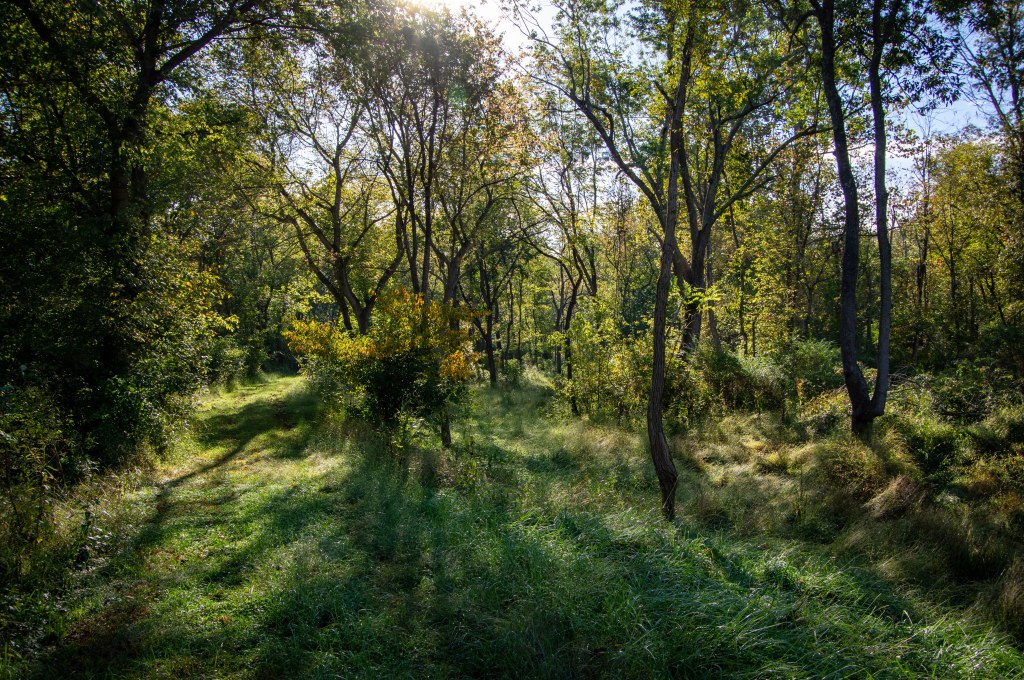
After we moved in, I asked some of our neighbors about it, and they called it “the mill race.” I didn’t know what that meant, though I knew we had a mill in town, and that the trail led about halfway to it. And then it occurred to me.
Beside the trail, there’s a little creek.
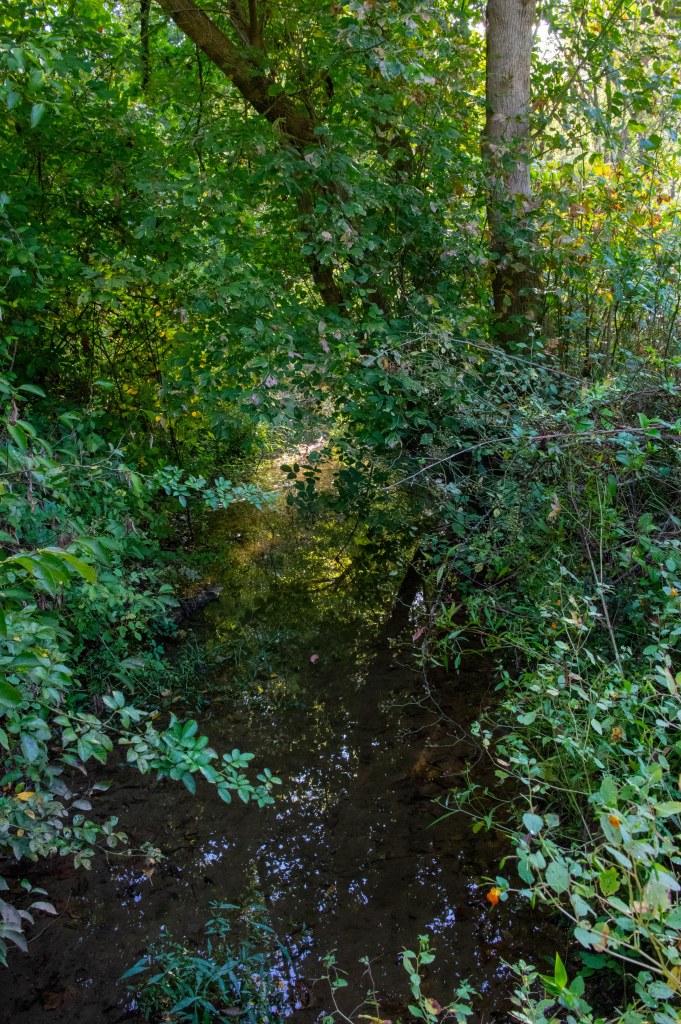
Or, at least, when we moved in, we thought it was only a creek. Turns out, it’s a race. And when neighbors told us about “the mill race,” they were talking about the creek, not the trail.
I did some digging and found this map, drawn by a noted local Loudoun County historian named Eugene Scheel.

So, as it turns out, we live along a head race. It starts at a small dam on the west end of the Village, and runs all the way to the mill on the east end.
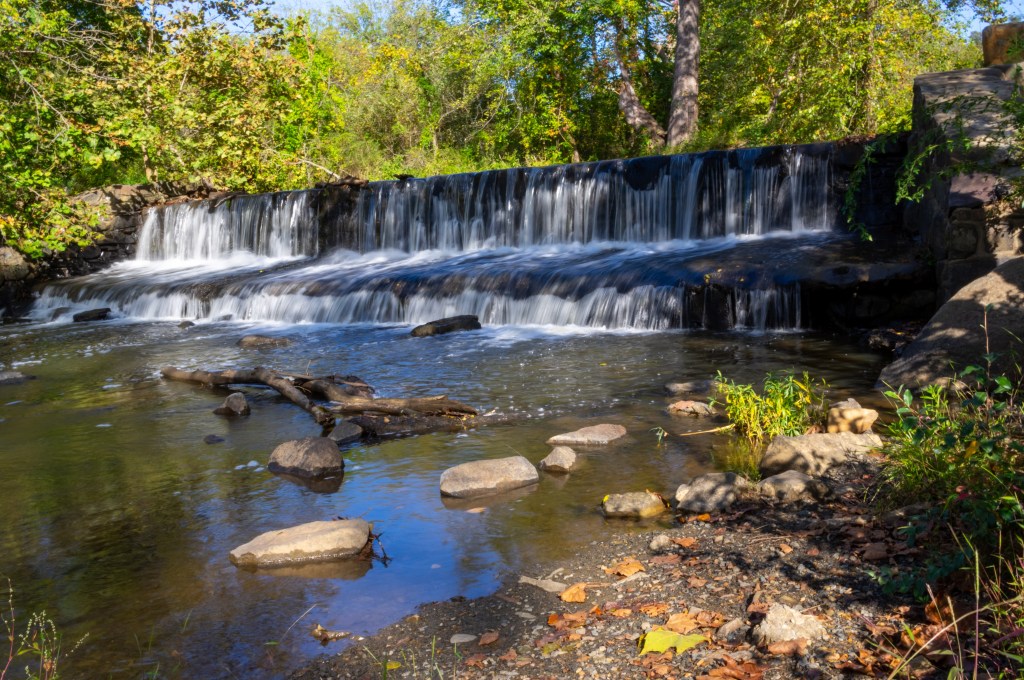
Pretty cool, right? I certainly think so. It’s another piece of history I get to experience every day.
Next week, I’ll write about the mill and share its story, so if you’re interested, be sure to check back on Friday, October 9th.
Until then, happy hunting, history adventurers!
Loudoun Local: History and Preservation in the Time of COVID-19
“Too often, discussions about preserving and investing in critical places is deemed non-essential or a nice thing to do in good times. But the COVID-19 pandemic has taught us that places are even more important in challenging times.” –Nicholas Redding
I came across this article a few weeks ago, and it got me thinking – what does historic preservation look like right now? And does it even matter in such a frightening and uncertain time?
I live in a historic village, built around a gristmill that dates back to 1807 and still functions today.

Sometimes, President James Monroe, who called this little village home in his later years, even comes to visit.

I’ve lived here since 2016, when my husband and I decided to do the crazy thing we’d been talking about for the last five or so years and buy a 200-year-old house. We have never regretted that decision, and I doubt we ever will. We live in a home with a story, where generations of families have lived before us, where people watched soldiers pass by on their way to a major cavalry battle and where we find evidence every day of just how much has changed in our little corner of the globe. Our house is part of America’s history, and we have the honor of serving as guardians of that history.

You don’t just live in a building this old. You experience it. And that applies to historic preservation, generally. It’s all about the experience, because there’s nothing quite like firsthand knowledge to help you appreciate exactly what you’re protecting. So, how do we approach historic preservation in this historic moment? And more specifically, how should we approach it where I live in Loudoun County?
Presence, engagement, and experiencing history online.
Take a look at some of our most well-preserved historic sites in America, and you’ll see people. Lots of people, physically present – walking on the battlefields of Bull Run and Gettysburg, watching reenactments at Williamsburg and Jamestown, exploring the homes of George Washington, Thomas Jefferson, Emily Dickinson, and Frederick Douglass (one of my favorites, that one). It is interesting, memorable, and valuable to immerse yourself in history.
But what do you do when you can’t?
In Loudoun, we’ve gone virtual. Loudoun’s Heritage Farm Museum has created a collection of online resources, their “Virtual Museum.” They’ve also become a pickup location for the Loudoun Made Loudoun Grown Marketplace, which itself has gone digital. The Mosby Heritage Area Association, a non-profit devoted to preservation through education, has created extensive online programming and hosts almost nightly events on their Facebook page (my favorite is “History on Tap,” and you should check it out). And Oatlands Historic House and Gardens has started a blog, “Oatlands Originals,” to share a virtual collection from their archives, and has begun hosting a video series for tours of the property, including the idyllic gardens and grounds managed by Mark Schroeter, a respected horticulturalist with extensive experience maintaining and curating historic gardens.

So many of our museums and non-profits in Loudoun have worked hard over the last several weeks to move their programming online, and to offer tours and education virtually. It’s not the same, sure, but it’s what we can do, right now.
Funding in the middle of a pandemic.
At the best of times, preservationists often have to fight tooth and nail for the funding they need. Unfortunately, desperate times often see that funding diminished, reallocated, or revoked altogether. Just recently, the Loudoun County Board of Supervisors voted to cancel funding for the Loudoun Museum, a move made more devastating by the fact that they’d previously approved that funding.
I’m not going to argue politics here. We are living through extraordinary times, and difficult decisions are being made at all levels of both civilian life and government. That being said, many museums, historic sites, and non-profits that promote preservation survive on donations from their communities. These are scary and turbulent times, though, and if you can’t offer financial support, you can still spread the word and be vocal about what you love. Word of mouth will never NOT be powerful.
Preservation requires passion.
And your voice is a resource, just like your dollar. Preserving historic sites often feels more like a battle than a project. No matter the issue – funding, recognition, apathy – preservation is tiring and sometimes thankless work.
In my village, we worked for the better part of three years to preserve several of our historic structures when our own elected representatives moved to demolish them. It took a petition with over 5,000 signatures, hours of phone calls and knocking on doors and answering questions and making statements at public hearings before we were finally heard. But we were, and the historic fabric of our village should hopefully remain intact for future generations of Loudouners to explore and experience.
Now, not even a year later, there’s a brand new issue, and a brand new petition, as the community works to protect a battlefield and the rural viewshed of a historically significant church and cemetery.

Loudoun’s elected representatives continue to look for quick and easy ways to solve problems, even if they directly conflict with public sentiment, and even though we’re in the middle of a pandemic that stifles public input and engagement. And no matter how this one ends, in another year, there will be another fight, and another after that.
The sad and difficult truth is that in a world always looking out for the next big thing, on the hunt for instant gratification, the long and labor-intense process of preserving historic structures and protecting historic areas is, for many, not a priority.
It takes energy and passion to make an impact in a world that too often just doesn’t care, and Loudoun County sits squarely in ground zero between the vital need for historic preservation and the rising tide of new suburbia.
Connecting through history and preservation.
Click on almost any piece of journalism about Loudoun County, and you’ll read about the stark divide between its suburban, technology-infused east and its rural, farm-economy west. Here’s one, for reference, aptly titled “A Tale of Two Counties.” It’s such a classic divide in America, and here in Loudoun, one of the richest counties in the country where eastern residents regularly enjoy winery weekends and polo matches in the west, it would be funny if it weren’t so damaging.
A few years ago, the Chair of the Board of Supervisors caused a minor kerfuffle when she remarked that she regularly hears people say “idiotic things” about the county’s rural west. She apologized, but the wound she prodded was open long before her election, and it has never really closed.
In the early 2000s, a group proposed secession of Loudoun’s rural west, and that sentiment lingers today, newly invigored by discussions around an updated comprehensive plan. Residents in the east complain when schools close for snow-covered dirt roads in the west, and in the west, long-time property owners worry about encroaching new development. And just today, a group of three supervisors sent a letter to Virginia governor Ralph Northam requesting that, unlike the rest of Loudoun County, the rural west be allowed to begin Phase 1 of reopening after a month-long stay at home order. Residents are divided on this, too, with many in support of loosening restrictions, and others concerned about the potential impacts of reopening too quickly.
In this climate of divided politics, opposing values, and different priorities, it’s hard to imagine anything might bring us together here in Loudoun, but we share a rich heritage and a unique history. They belong to all of us. Loudoun’s story is America’s story, from battlefields and farmhouses to office buildings and suburbs. When we invest our time, our energy, and our resources in preserving our historic spaces for future Loudoun residents, we reconfirm our connection to this shared experience. When we agree that historic places matter and deserve to be protected, we recommit to moving forward together. Perhaps now, more than any other time in recent memory, Loudoun County needs its preservationists.
“We remember the tremendous power that physical, authentic places hold in our lives. Places provide the setting to embrace our desire to connect and engage. We must remember that feeling as we rebuild.” –Nicholas Redding
 A Virginia Writer's Diary