Moments and Moments of Silence

My Grandpa James fought in World War II.
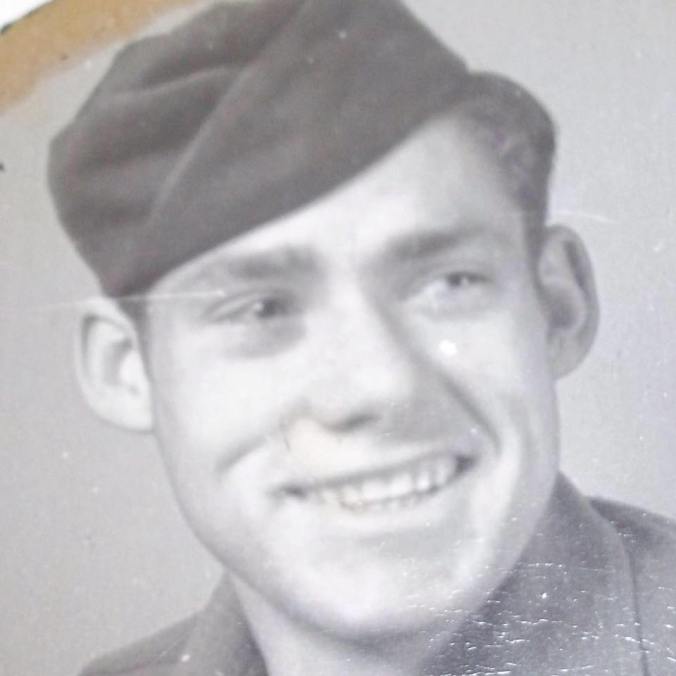
I’ve known that my whole life, but the older I get, the more I understand what it cost him.

I did a research paper my senior year of high school, and I interviewed him for it. I asked him for some memories of the war. Nearly everything he shared with me was about his time as a brand-new recruit, still on US soil – a train ride out west for basic training, signing up in the first place, waiting and waiting. And then, on the way to Italy, his ship almost broke apart. But that’s as close to Europe as he brought me. What I know now, I know because my he told my uncles, who told my mother, who told me.

I won’t share his stories here. They’re not truly mine. And they’re hard and heartbreaking.

I understand why he never told me, never talked about them.

I will tell you he had nightmares. I didn’t know that either, for a long time. And when he woke up in the morning, he didn’t talk about them.

I wonder now – he’s been gone since 2015 – I wonder now just how much he never said. I wonder how much he carried, how heavy it sat on his strong mountain-man shoulders, how horrible that silence felt, and how much of him I never got to see because those parts were busy carrying that terrible weight, in total silence.

Silence and silence and silence, for all the years of his life. He lived to 90.

When I take a moment of silence now and remember the veterans, his is the silence I feel in my bones. His is the silence I can’t get out of my head.

It’s incredible how loud silence can be.

I’ll never know all his war stories. But I know that he fought, and that he lost friends, and that we, our country, won. I know he came home and built a family and loved them with everything he had. I’m proud to be part of that family.

I’m proud of him.

A Grandfather’s Story

Veteran’s Day always makes me think of my grandfather, my favorite veteran.

He died in 2015. He didn’t talk much about his service, at least not to me. What little I do know, I’ve learned from my mother, and I’m always trying to piece it together in stories, because those are all I have left of him now. I wonder how many grandchildren could say the same thing.

Here’s something I wrote not long after he died. I thought I might include it in a larger work (that still isn’t done, and might never be).

Some of it’s true.

************

At a fork in an old country road, surrounded by rocky fields and green mountains and flanked on both sides by cracked pavement, sits an old white farmhouse. Its shutters and clapboard are going grey, its chimney is crumbling, and any reminder that it used to be part of a functioning farm is long gone, replaced by overgrown patches of wild onions and cattails. There’s no sign now that it ever housed a family. This is the house where my grandfather grew up, nestled outside of a small Appalachian town.

The land is called Hell’s Half Acre, and my grandfather knew, when he was a boy, that he’d have to work it. Walking home from school, a satchel of books swinging in his hand, he wondered every day if it would be the last he’d make the trek. And one day it was. He left school in seventh grade, a servant to the farm. It was that, he told my mother, or be sold to another family, one with the resources to afford another mouth to feed.  Instead, he used his hands to work. Evenings on the farm, and days underground, laying wood for mine shafts. And each day, he’d stare at the fork in the road, and wonder if he’d ever get to choose any direction at all.

“When I grow up,” he said to himself, eating dinner at a quiet table full of tired, hungry people, between gulps of buttermilk and bites of toasted biscuit, “when I grow up…” He didn’t dare dream of that time. Dreaming felt hopeless, not an escape but a trap, a long, dark tunnel with no light at the end. 

Then, when he turned sixteen, there came a war.

“I’m going to sign up,” he said to his brother, and he did. He lied about his age, though not by much, and found himself on a train west, to basic training somewhere in the Dakotas. And then a ship east, to Africa. And then a ship north, to Italy. And it was there, sleeping in empty towns and eating blood-spackled bread, that he met a girl. Sort of.

Back home, my grandmother was reading books by flashlight every night, hiding under her covers from a father who thought women shouldn’t read and a step-mother who wore her dead mother’s clothes. Sometimes, in the quiet, heavy darkness, my grandmother would talk to her sister, who died when they were both very young, because she had no one else to talk to. 

“Lucy,” she’d say, “when I grow up…” And she’d pause. “When I grow up…”  And she couldn’t finish the thought. When she grew up, she would be some man’s wife, some child’s mother, and finally some graveyard’s newest coffin.

And then one day, she sent a picture and a letter to a soldier from the county, off fighting in a war that involved the whole world. And it changed everything.