For whatever it is,
no matter how far,
keep going.
There’s more than enough
sky up there
for all your dreams
and then some.

For whatever it is,
no matter how far,
keep going.
There’s more than enough
sky up there
for all your dreams
and then some.
You’re talking to me,
I know,
and I sort of, mostly hear you.
See, I’m not quite here
(though not quite not) –
I’m somewhere else,
far away
right in front of you.
It’s not one place,
so I can’t tell you where,
or when,
or exactly how I came to be there.
Or even, truthfully,
when I might be back.
You’re frustrated,
I can tell,
but just consider this:
How wonderful to travel
without tickets
or borders
or worries about time and money
and a place to stay.
I’m lucky, I think.
Now…
…what did you say?
The winter ground had thawed and gone warm and soft on Spring Mountain when my grandmother first told me about the child.
“Wild as a fox at midnight,” she said. “But pretty as a picture.”
We were walking together from the church in town to the pharmacy on a sunny Sunday morning. My grandmother needed to pick up some medicine for my grandpa, and she’d promised me a Cherry Fizz if I came along quietly.
“Who was she, granny?”
“Well, here in town, they reckon she came from up on the mountain. No one’d ever seen her before.”
“But how’s that even possible? A little kid couldn’t live up there all alone.”
“Well, I never said she was alone,” my grandmother answered me, “now did I?”
“So she had a family?”
“No one knew,” my grandmother said. “She just appeared one day, like she’d been here all along. She sat out by the old ball field and watched the boys play a while, then she wandered off again.”
“What’d she look like?”
“She was just a little thing,” my grandmother said. “She had light blonde hair and blue eyes. Some people said she looked like she wasn’t quite of this world.”
We’d turned into the pharmacy by now, and my grandmother shopped while I sat at the counter with my Cherry Fizz.
“…holdin’ out long as he can…”
That was Granny.
“…making arrangements?”
Mr. Stevens, the pharmacist.
I knew they were talking about my grandfather. He’d been sick for a long time, as long as I’d been alive, it felt like. Other kids got to fish, or play ball, but my grandpa had never been well enough for any of that. So we played chess, and watched his shows, and drank Mountain Dew floats together on the front porch. I wanted him to live forever, but lately, his hands were too shaky and sore for board games, and he’d fall asleep in the middle of the news. He always told me you should watch the news. I knew Mr. Stevens and my grandmother were talking about Grandpa, and I didn’t like what I was hearing.
“Granny,” I yelled. “You done?”
My grandmother sauntered over and looked at me, stern and sharp, and said, “You remember our deal?”
“Yes’m,” I said, my head bowed.
“Just sit quiet until I’m done. Won’t be long, I promise.”
I did as I was told, and I did my best to tune out everything around me until I felt Granny’s hand on my shoulder.
“Ready steady,” she said.
“Ready,” I told her.
We set off towards Granny’s house, two blocks away and a couple of streets back.
“Granny,” I said.
“Hmmm,” she replied. She seemed somewhere far away, I thought.
“How’d you meet Grandpa?”
“I liked to run,” she said.
“Huh?”
“When I was a little girl,” she said, “I liked to run. I could outrun any of the boys, easy, and they didn’t much care for that. Or for me.”
“I can’t imagine anyone not liking you,” I said.
And I really couldn’t. My grandmother made dinners for the sick and carried groceries for the weak and always had candy in a crystal jar on the coffee table. She ran church luncheons like no one else could. She took the time to decorate every little part of her house at Christmas. Who wouldn’t like her?
“Things were different back then,” she said. “I was different.”
“Different how?”
“Well, I was new, for one thing. My family moved here when I was about seven. They kept to themselves, and that was different.”
“Okay,” I said. “But different doesn’t mean bad.”
“No, it sure doesn’t,” she said. “But I think we sort of scared people, my folks and me. I liked being outside, playing in the creek and getting my hands dirty. I liked the way the dirt felt, like it was something alive.”
“Ew,” I said.
“And I liked worms and bugs,” she added, and looked down at me with a toothy grin.
“Gross!”
“I didn’t go to school, since my parents taught me at home. I didn’t know a lot of people, but I sure liked to run, and I’d come into town every Saturday to play with the other kids.”
“They weren’t scared?”
“Oh, they were. But I think they wanted to prove they were brave,” she said. “They liked the challenge. Boys…” she said.
“So how’d you meet Grandpa, then?”
“Your grandpa was never much of a runner,” Granny said. “He’d sit off to the side, and he never really talked to me, but every time I won a race, he’d smile.”
“He liked you,” I said, in that kind of sing-song voice that kids always use.
“I reckon he did,” she said. “And one day, I sat down and said hello.”
“What’d he say back?”
“I guess it was hello,” Granny answered. “But you know, I don’t much remember, because we were always together after that, and we talked about a lot of things. I remember all of that, but not the first thing he said to me. Isn’t that sad?”
“Yeah,” I told her. “It is.”
“He didn’t like to run, but he did like the woods, and so he’d come up the mountain with me and we’d walk and talk. I’d show him my favorite bugs, and he’d show me his favorite flowers.”
“Grandpa doesn’t go in the woods anymore,” I said.
“No,” Granny replied. “No, he can’t move around like he used to. But we had lots of good years up in those woods.”
“I like that,” I said.
“I did, too,” she said. “I like our house just fine, but I love the mountain. Your grandpa does, too.”
“So that’s why you married him, then? Because he liked the woods?”
Granny laughed. “Oh, sweet pea,” she said, “there were all sorts of reasons. He liked the woods, and he liked me, and he was even nice to my parents. Came all the way up to their cabin and asked my father if he could marry me. Wasn’t one bit scared.”
“Do you miss those days?”
She looked out and ahead, and sighed. “I do, all the time. But I’m happy with life here. It’s darn good, in fact. Grandpa says he tamed me, and I say I couraged him.”
We walked for a bit in silence, until we got to their house. Grandpa and Granny lived in a brown and tan Craftsman cottage with a big front porch and a yard full of flowers. I loved that house. I love it, still.
We walked up the steps and Granny was just about to open the door. I looked up at her, at her long, light hair, tied in a bun on the nape of her neck. At her blue eyes that wrinkled when she laughed big.
“Granny,” I started, and then stopped myself. Even young as I was, I thought it wasn’t possible, and then I thought, well, if she wanted to tell me, one day she would.
“Go on now,” she said. “You can’t be starting something and not finishing. Ask what you wanted.”
“Are you her? The girl from the mountain. Is that you?”
She laughed again, a big, wide laugh and slapped her knee. “Oh, lord, child, is that what you think?”
I shook my head, vigorously. But then, I nodded, just small enough for her to see.
“If’n I was,” she said, “I’d tell you this: There’s a little wild in all of us, no matter where we come from.” And then, she winked.
I’d like to think my grandmother was the little wild child from Spring Mountain. I’d like to think she never lost that part of her, and that some part of me carries it, too.
************
Thank you for reading! This is the third of twelve stories I’ll write for my 2023 Short Story Challenge. The theme this year is: Wild.
Here are the first two, if you’d like to read them:
I hope you join me and write some stories of your own this year! It’s fun, and I hope this will be a happy year full of good stories. But just reading is fine, too, and I’m glad you’re here.
The next story will be posted at the end of April.
How funny,
to race against
a stationary object,
as if time cares
about our projects
and our deadlines.
The clock ticks and tocks –
it does not see
or know
or participate
in the too-fast days
of our lives.
And really,
we build them that way,
don’t we?
We fight with the
never-ending turning of the globe,
like boxers in a celestial ring,
but the ring is empty,
save for us
and all of our to-do lists.
Wouldn’t it be nice,
then, to just stop –
not the clock,
but ourselves –
and insist on a slower pace?
And why don’t we?
I mean, seriously,
who ever made the rule
that busy is better?
I’d rather not be,
thank you.
I’m not mad, exactly,
but I do think this is bad.
See, the work will
truly
always
be here.
But I won’t.
All around, I hear it:
The hum of new life –
of growing things,
buzzing and flying,
a gentle flap of beating wings,
the stir of wind through the blossoms –
this song that each year nature sings.
It seems that here,
in a season and a blur,
no more than a blink,
we are suddenly,
all of us,
ready for spring.

I mean, sure, of course
I want to win.
But, it’s just as fun to lose
when losing is still learning
and learning is knowing
and knowledge is power.
And when I think of
how much I know now
that I didn’t know before,
I’m happy that my hobby
is a trivial kind of pursuit.

And sometimes,
friendship
truly feels as simple as
sitting quietly
together
(waiting for your humans
to drop some food
on the floor).

It’s International Women’s Day! Unfortunately, I’ve been feeling under the weather, so I haven’t done much to celebrate, and my brain feels too foggy to write something really good. So, I’ll just say this:
I’m thankful for the amazing women in my life, and the strong, brave women who came before us. I’m proud of the women who dream, and who love, and who go on when it feels impossible. We are heroes, rock stars, the glue that keeps this broken world together. If I had to choose a million times, I would still choose to be a woman, even when it’s hard and unfair. I carry the universe in me. All women do.
And I’ll share a couple of my favorite poems I’ve written in the past. I hope you enjoy them! And I hope that you tell the women in your life today – and yourself, if you’re a woman (yes, ALL women) – just how wonderful and unbreakable and valuable and worthy and loved they are.
************
To the Women Who Came Before
To you,
the women,
the warriors and weavers and
witches and wanderers,
the brave and bold
who came before,
I promise this:
My light will magnify your light.
I will shine because
you reached for the sky
and grabbed the sun and moon and stars
to fight the darkness.
Your words,
your courage,
your heart,
your home –
the one you made with your own hands –
will live on in me.
I will stand and speak.
My voice will carry as yours,
over the mountains you climbed,
across the sands of time
and the pillars and platforms you built.
I won’t make myself small
just to fit into the corners
of a world made and sustained
by mothers.
I cradle your wisdom in my soul
because you carved a place for it.
I will keep that place
sacred and whole.
I will nurture the fire you lit
and pass the eternal torch.
************
Eve
A story we’ve heard:
The first of us all
(to fall) –
help-meet and wife,
made and prized,
then punished,
removed and reviled.
The woman who
became a warning.
And history became
both judge and jury,
gave us no choice,
no voice.
The story became ours,
but it never belonged to us.
And before, and now,
down in our bones
we know it.
We know:
It is human to fall
and rise again,
to seek,
to learn,
to live in curiosity.
And so,
can we reclaim her,
weave her story anew
and see her,
this mother of mothers?
Blood of our blood –
can we finally love
(not blame)
her?
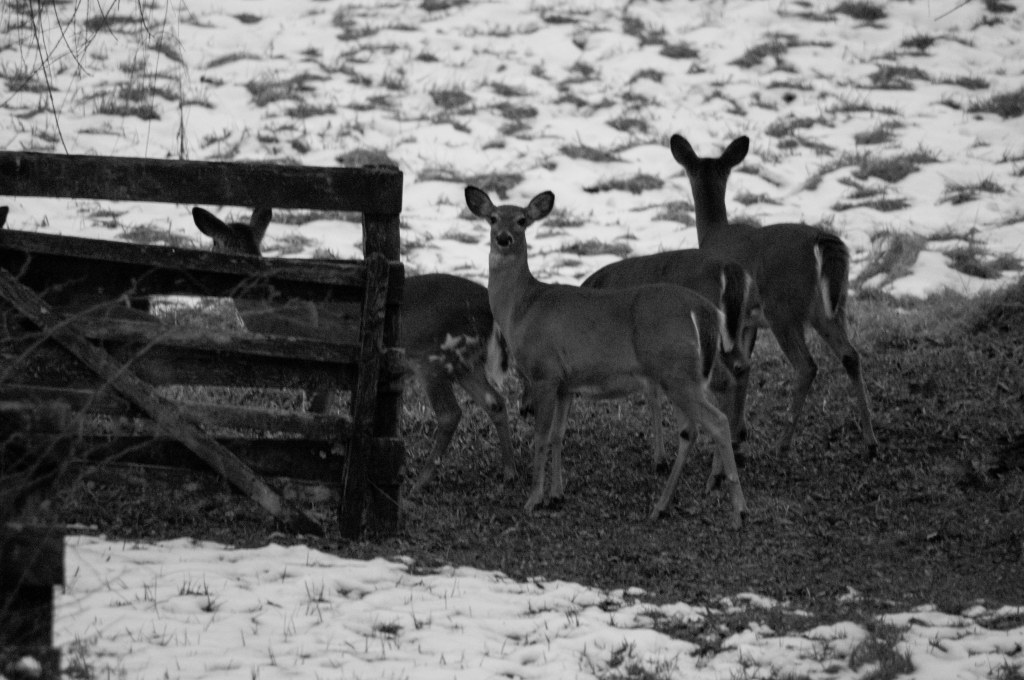
I wanted a wintry winter.
Well, seems I might get it in spring.
It’s a funny, frustrating thing,
that we can’t rely on Virginia’s weather,
fickle and peculiar as it is.
But at least there’s this:
Foxes in the meadow,
deer under the willow,
velvet gray skies and
a fire’s crackling glow,
and warmer days ahead.
(I hope.)
Once upon a time, the queen of the faeries fell in love with the king of the coffee shops.
They lived in a different kind of forest, where the tall trees were made of metal and brick, and the meandering paths were dark as pitch and hard as rock. This forest was loud and fast. The queen and the king knew of no other world, no better world, than this land of perpetual motion, this place that never slept.
It so happened that on the night the queen first saw the king, the forest lay blanketed in a wet, heavy tarp of snow, and the wind blew frigid and swift through the corridors of steel and stone. From her perch above the world, looking down upon her kingdom from the highest of the towers, the queen saw the king, wrapped tightly in his winter coat and bracing himself against the icy gale.

And she thought to herself that she’d never encountered a living thing more handsome.
But the queen of the faeries knew very little about humans, and so she devised a plan. In the days that followed, she watched him, followed him from his small room into the busy streets, memorized his daily rhythms, studied his life. Soon enough, the cold days turned warm and soft, and the air filled with the scent of blossoms and new life. The queen decided the time had come.
“This is foolish,” said one of her attendants, as she pulled a brush through the queen’s thick mane of hair.
“She’ll be bored of him soon enough,” answered another. “Human lives are short and sad.”
But the queen would not be deterred. That morning, as the sky turned pale and light, she gathered her closest confidantes around her and said: “I am not certain how long I might be away, but I must go. Be well, and think of me.”
And she turned away and left them. Had she stayed, she would have noticed their scoffing, giggling, the worry and doubt on each wary face.
“This will not end well,” she would have heard whisper.
The queen was not afraid, though she was not unafraid either. There was a new feeling in her heart, something fierce and unrelenting, begging to be set free. Love, she knew. Love, she’d heard, sends ships to the ends of the earth, men to their deaths, and now, she thought, a queen into a great unknown.
The brass bell above the door to King’s Coffee jingled a merry chime as she walked through it, hands trembling, face aflame. But she would do this. She approached him, the king, there behind the counter, and took a breath to speak.
“Morning,” he said, before she’d gathered her words. “Beautiful today, right? What can I get you?”
The queen had prepared for this moment.
“A cappuccino,” she answered. “Extra foam.”
And she smiled, her brightest, biggest smile, one that had melted hearts and broken armies, one that demanded notice, demanded a reaction, demanded submission.
“Sure,” he said. He looked away from her, down and to the left. He met her eyes again with a cup and a marker in his hand. “Name for that order?”
This, thought the queen, was not going according to plan.
“Um,” the queen began.
“Uma?”
“No,” said the queen. “My apologies. You may call me Anna.”
“Got it,” he said, and scribbled something illegible on the cup.
“And yours?”
“Excuse me?”
“Your name,” said the queen. “It is only fair, a name for a name.”
“That’s a new one,” said the king. And then he smiled back at her, just a quick flash, there and gone. Enough for a hope. And he said, “It’s Nick.”
Love had a name, thought the queen. “Nick,” she repeated. “It’s wonderful to meet you, Nick.”
“Same,” he said, but added, with a note of apology in his voice, “it is. But, uh, if you could move down. There are other customers.”
The queen looked behind her then, and saw a long line of irritated faces. And someone elbowed her, actually elbowed her, out of the way.
These creatures, she thought, are beastly.
She waited at one side of the counter, and when her name was called, realized it was not Nick who would hand her cup to her.
“Thank you,” she said, nonetheless, and walked out, head down, and into the spring air.
A lesser being might feel discouraged. A weaker one might use magic.
“And I could,” the queen said to herself. “I could, and this would be done. He would be mine.”
But the queen did not want a king compelled to love her. What purpose in that? And so she returned, day after day, determined to know him better, and to win his heart.
The first morning she returned to King’s Coffee, Nick did not recognize her.
“Morning,” he’d said. “What can I get you?”
“Anna,” she told him.
“Right! Anna.”
“Cappuccino,” she said. “And thank you, Nick.”
He smiled, and she felt it again. Hope. There was hope.
The queen spent most of her time in King’s Coffee after that, though Nick did not always realize it. One day, glamoured as a tall, thin woman with dark hair and blue eyes, and the next, as a woman short, stout, and fair, today one person, tomorrow another, and each morning, always, just Anna, ordering her coffee. Nick’s routines were simple and kind. He’d help one customer, then the next, always with a cheery smile and a ready greeting. But the queen found she was not, as a whole, very fond of people. For every person who accepted Nick’s gentle friendliness, there seemed to be one who recoiled, who snapped, who grimaced and cursed.
One morning, ordering her “usual,” as Nick called it, she told him, “I want you to know that I find you an exceptionally nice person, Nick.”
She saw it, knew she hadn’t imagined that Nick’s cheeks had begun to turn a delightful shade of pink.
“Just doing my job,” he said.
“Well,” the queen added, “then you do your job much better than I would. I would not have the patience.”
Nick laughed, and how the queen loved the sound of it. “You’d surprise yourself, I bet,” he told her.
“Perhaps,” said the queen.
“Service isn’t a great job,” Nick told her, “not all the time, anyway. But I get to meet a lot of people, and most of them really are fine. Some are them are great.” He winked as he added, “Like you.”
The queen decided to sit down that day, as herself, at a little table in the corner. She caught Nick’s eye a few times, as he worked, and each time, it seemed some message passed between them, something more, better, something thrilling. She was drawn out of her reverie by a familiar voice.
“They are a rough and mannerless bunch, are they not?”
The queen’s eyes focused on her closest friend, sitting comfortable in the seat across from her, as if she’d been there the whole time.
The queen nodded and said, “Some of them, yes.”
“You must come home,” her friend said. “Your people need you.”
The queen closed her eyes, rubbed her temples, a decidedly human behavior she had somehow acquired, and said, “I can’t. I won’t. My heart will not allow it.”
“Your heart will destroy all that you have built.”
“Then let it,” said the queen. “I cannot tame it.”
Especially not now. Not now that something was shifting, changing. The queen could feel it. She was close, her goal in sight. Her love, her hope, near enough to reach out and touch. Almost.
The queen woke the next day determined. She would move this forward, and by the end of this day, she and her king would “have plans,” as she’d heard those around her say. Perhaps dinner, as seemed to be a popular choice. She would ask him. He would say yes.
But it was not Nick who greeted her that morning.
“Where is Nick?” she asked.
The man behind the counter did not smile. He barely looked at her at all. He focused instead on the line forming behind her, on worrying his hands with cups and a marker, and on plunking numbers into the register. “Accident,” he said. “Last night. What do you want?”
“I don’t understand,” the queen said, even as she felt her chest tighten, felt her stomach flip and her legs go weak and unsteady beneath her.
“Look, lady, I’m not here to answer your questions. Do you want coffee or not?”
“I’m fine,” she said. “No thank you.”
The queen turned, walked toward the door, and felt a tug on her shoulder.
“He talked about you last night,” said a small voice behind her. One of Nick’s compatriots, someone she’d seen often. “After you left. Said he was going to ask you out today.” The girl sniffled, wiped at a tear in her eye. “I just thought you should know,” she said, and choked on a sob. “I just can’t believe it.” And then she hurried to the back.
The queen walked out the door, into the daylight of a stark new reality.
“We told you this would end badly,” said her friend, again appearing from nowhere, hanging close by her side. “Human lives are fragile.”
And it was true that the queen did not understand death, not in the way that Nick would, that humans seemed to, and that she wished she could.
“I saw him yesterday,” she said. “He was just here.”
“Come home,” said her friend.
The queen could not, and did not, for a long, long time. She wandered dark paths, both within and without. She lived among the wild, lonely things, as she herself felt. Only when the pain dulled, when the weight of it began to left, did she return to her own kind and to her kingdom, though she was not the same queen. They say she was changed, perhaps forever.
“Are you happier, for having known him?” Her friend asked her this, one night, many years later.
“I am happy and sad, and lonely, and angry,” answered the queen. “I did not know I could feel so much.”
And they say she loves him still, the kindly king of coffee. They say her heart will never heal, will never be whole again, that some wounds will always remain open and aching. And that she watches, like a sentinel, from her favorite place upon the highest tower, far above that land of noise and motion and metal and coffee, for the day when her king, her Nick, will return to her once more.
************
Thank you for reading! This is the second of twelve stories I’ll write for my 2023 Short Story Challenge. The theme this year is: Wild.
Here’s the first one, from January: Dark, Dark, Dark
I hope you join me and write some stories of your own this year! It’s fun, and I hope this will be a happy year full of good stories. But just reading is fine, too, and I’m glad you’re here.
The next story will be posted at the end of March.
 A Virginia Writer's Diary