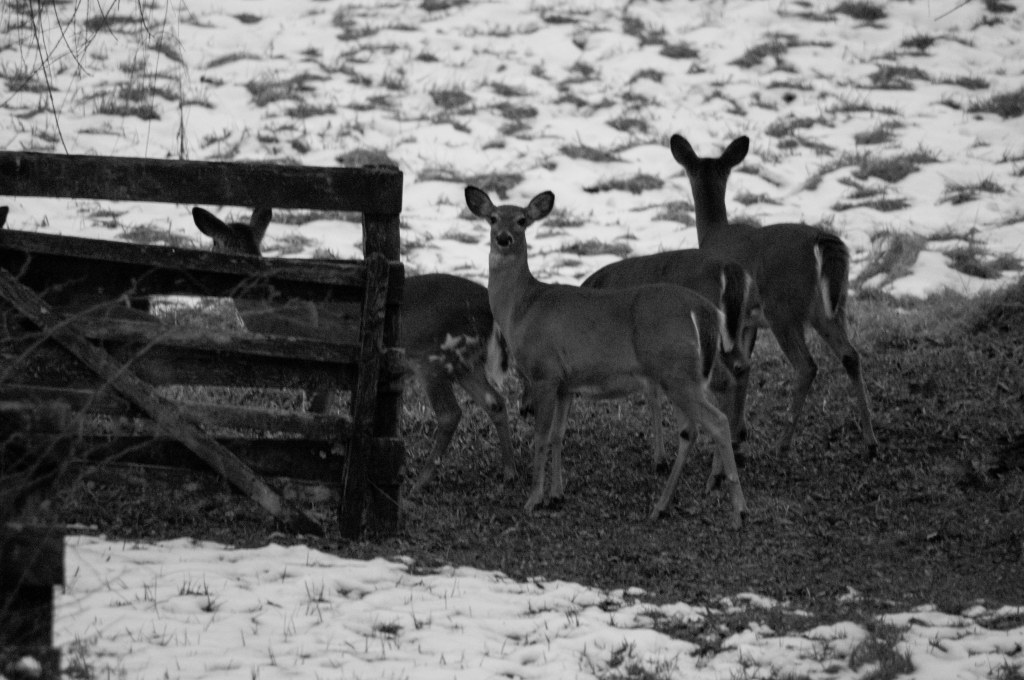
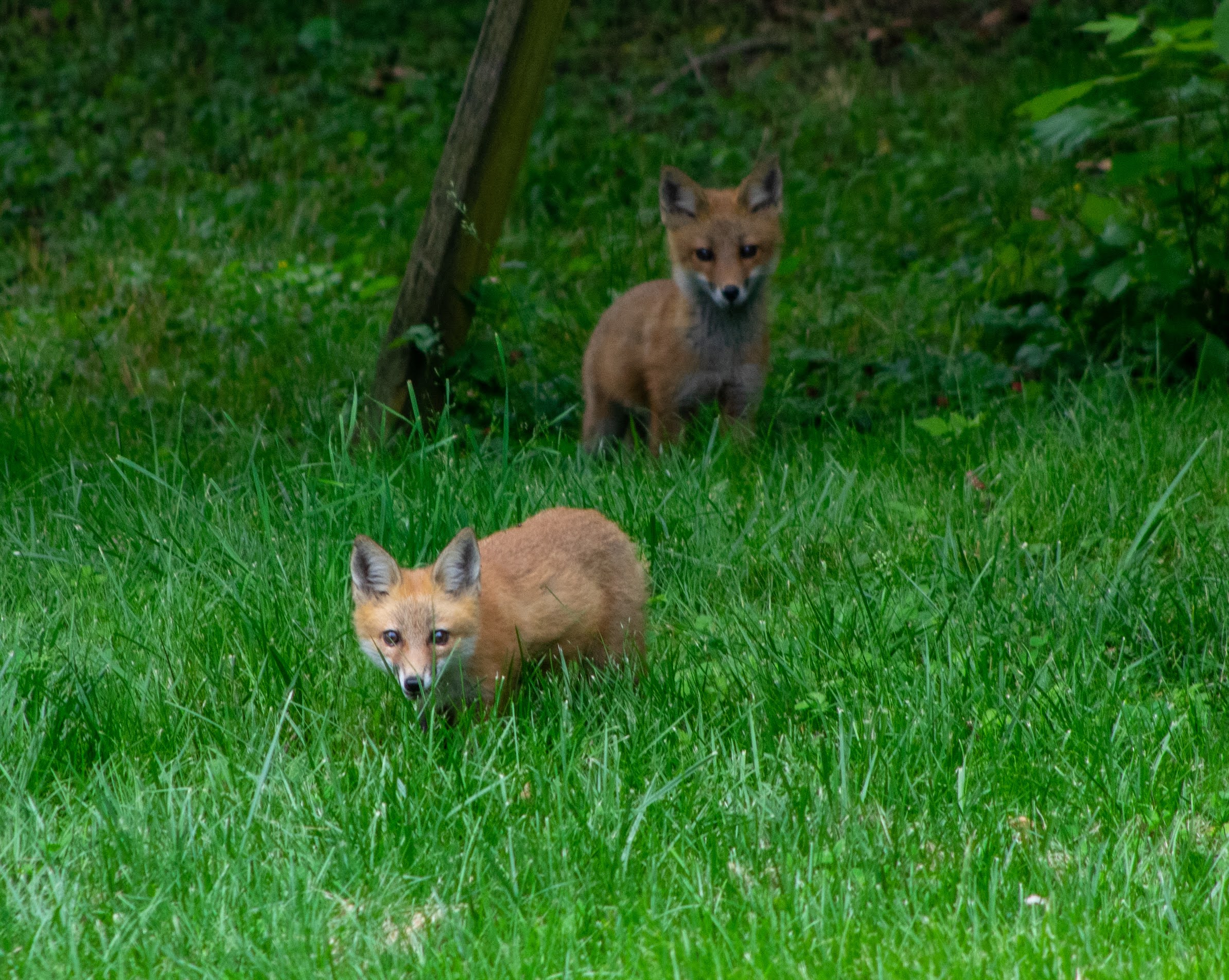
I wanted a wintry winter. Well, seems I might get it in spring. It’s a funny, frustrating thing, that we can’t rely on Virginia’s weather, fickle and peculiar as it is. But at least there’s this: Foxes in the meadow, deer under the willow, velvet gray skies and a fire’s crackling glow, and warmer days ahead. (I hope.)
Once upon a time, the queen of the faeries fell in love with the king of the coffee shops.
They lived in a different kind of forest, where the tall trees were made of metal and brick, and the meandering paths were dark as pitch and hard as rock. This forest was loud and fast. The queen and the king knew of no other world, no better world, than this land of perpetual motion, this place that never slept.
It so happened that on the night the queen first saw the king, the forest lay blanketed in a wet, heavy tarp of snow, and the wind blew frigid and swift through the corridors of steel and stone. From her perch above the world, looking down upon her kingdom from the highest of the towers, the queen saw the king, wrapped tightly in his winter coat and bracing himself against the icy gale.
And she thought to herself that she’d never encountered a living thing more handsome.
But the queen of the faeries knew very little about humans, and so she devised a plan. In the days that followed, she watched him, followed him from his small room into the busy streets, memorized his daily rhythms, studied his life. Soon enough, the cold days turned warm and soft, and the air filled with the scent of blossoms and new life. The queen decided the time had come.
“This is foolish,” said one of her attendants, as she pulled a brush through the queen’s thick mane of hair.
“She’ll be bored of him soon enough,” answered another. “Human lives are short and sad.”
But the queen would not be deterred. That morning, as the sky turned pale and light, she gathered her closest confidantes around her and said: “I am not certain how long I might be away, but I must go. Be well, and think of me.”
And she turned away and left them. Had she stayed, she would have noticed their scoffing, giggling, the worry and doubt on each wary face.
“This will not end well,” she would have heard whisper.
The queen was not afraid, though she was not unafraid either. There was a new feeling in her heart, something fierce and unrelenting, begging to be set free. Love, she knew. Love, she’d heard, sends ships to the ends of the earth, men to their deaths, and now, she thought, a queen into a great unknown.
The brass bell above the door to King’s Coffee jingled a merry chime as she walked through it, hands trembling, face aflame. But she would do this. She approached him, the king, there behind the counter, and took a breath to speak.
“Morning,” he said, before she’d gathered her words. “Beautiful today, right? What can I get you?”
The queen had prepared for this moment.
“A cappuccino,” she answered. “Extra foam.”
And she smiled, her brightest, biggest smile, one that had melted hearts and broken armies, one that demanded notice, demanded a reaction, demanded submission.
“Sure,” he said. He looked away from her, down and to the left. He met her eyes again with a cup and a marker in his hand. “Name for that order?”
This, thought the queen, was not going according to plan.
“Um,” the queen began.
“Uma?”
“No,” said the queen. “My apologies. You may call me Anna.”
“Got it,” he said, and scribbled something illegible on the cup.
“And yours?”
“Excuse me?”
“Your name,” said the queen. “It is only fair, a name for a name.”
“That’s a new one,” said the king. And then he smiled back at her, just a quick flash, there and gone. Enough for a hope. And he said, “It’s Nick.”
Love had a name, thought the queen. “Nick,” she repeated. “It’s wonderful to meet you, Nick.”
“Same,” he said, but added, with a note of apology in his voice, “it is. But, uh, if you could move down. There are other customers.”
The queen looked behind her then, and saw a long line of irritated faces. And someone elbowed her, actually elbowed her, out of the way.
These creatures, she thought, are beastly.
She waited at one side of the counter, and when her name was called, realized it was not Nick who would hand her cup to her.
“Thank you,” she said, nonetheless, and walked out, head down, and into the spring air.
A lesser being might feel discouraged. A weaker one might use magic.
“And I could,” the queen said to herself. “I could, and this would be done. He would be mine.”
But the queen did not want a king compelled to love her. What purpose in that? And so she returned, day after day, determined to know him better, and to win his heart.
The first morning she returned to King’s Coffee, Nick did not recognize her.
“Morning,” he’d said. “What can I get you?”
“Anna,” she told him.
“Right! Anna.”
“Cappuccino,” she said. “And thank you, Nick.”
He smiled, and she felt it again. Hope. There was hope.
The queen spent most of her time in King’s Coffee after that, though Nick did not always realize it. One day, glamoured as a tall, thin woman with dark hair and blue eyes, and the next, as a woman short, stout, and fair, today one person, tomorrow another, and each morning, always, just Anna, ordering her coffee. Nick’s routines were simple and kind. He’d help one customer, then the next, always with a cheery smile and a ready greeting. But the queen found she was not, as a whole, very fond of people. For every person who accepted Nick’s gentle friendliness, there seemed to be one who recoiled, who snapped, who grimaced and cursed.
One morning, ordering her “usual,” as Nick called it, she told him, “I want you to know that I find you an exceptionally nice person, Nick.”
She saw it, knew she hadn’t imagined that Nick’s cheeks had begun to turn a delightful shade of pink.
“Just doing my job,” he said.
“Well,” the queen added, “then you do your job much better than I would. I would not have the patience.”
Nick laughed, and how the queen loved the sound of it. “You’d surprise yourself, I bet,” he told her.
“Perhaps,” said the queen.
“Service isn’t a great job,” Nick told her, “not all the time, anyway. But I get to meet a lot of people, and most of them really are fine. Some are them are great.” He winked as he added, “Like you.”
The queen decided to sit down that day, as herself, at a little table in the corner. She caught Nick’s eye a few times, as he worked, and each time, it seemed some message passed between them, something more, better, something thrilling. She was drawn out of her reverie by a familiar voice.
“They are a rough and mannerless bunch, are they not?”
The queen’s eyes focused on her closest friend, sitting comfortable in the seat across from her, as if she’d been there the whole time.
The queen nodded and said, “Some of them, yes.”
“You must come home,” her friend said. “Your people need you.”
The queen closed her eyes, rubbed her temples, a decidedly human behavior she had somehow acquired, and said, “I can’t. I won’t. My heart will not allow it.”
“Your heart will destroy all that you have built.”
“Then let it,” said the queen. “I cannot tame it.”
Especially not now. Not now that something was shifting, changing. The queen could feel it. She was close, her goal in sight. Her love, her hope, near enough to reach out and touch. Almost.
The queen woke the next day determined. She would move this forward, and by the end of this day, she and her king would “have plans,” as she’d heard those around her say. Perhaps dinner, as seemed to be a popular choice. She would ask him. He would say yes.
But it was not Nick who greeted her that morning.
“Where is Nick?” she asked.
The man behind the counter did not smile. He barely looked at her at all. He focused instead on the line forming behind her, on worrying his hands with cups and a marker, and on plunking numbers into the register. “Accident,” he said. “Last night. What do you want?”
“I don’t understand,” the queen said, even as she felt her chest tighten, felt her stomach flip and her legs go weak and unsteady beneath her.
“Look, lady, I’m not here to answer your questions. Do you want coffee or not?”
“I’m fine,” she said. “No thank you.”
The queen turned, walked toward the door, and felt a tug on her shoulder.
“He talked about you last night,” said a small voice behind her. One of Nick’s compatriots, someone she’d seen often. “After you left. Said he was going to ask you out today.” The girl sniffled, wiped at a tear in her eye. “I just thought you should know,” she said, and choked on a sob. “I just can’t believe it.” And then she hurried to the back.
The queen walked out the door, into the daylight of a stark new reality.
“We told you this would end badly,” said her friend, again appearing from nowhere, hanging close by her side. “Human lives are fragile.”
And it was true that the queen did not understand death, not in the way that Nick would, that humans seemed to, and that she wished she could.
“I saw him yesterday,” she said. “He was just here.”
“Come home,” said her friend.
The queen could not, and did not, for a long, long time. She wandered dark paths, both within and without. She lived among the wild, lonely things, as she herself felt. Only when the pain dulled, when the weight of it began to left, did she return to her own kind and to her kingdom, though she was not the same queen. They say she was changed, perhaps forever.
“Are you happier, for having known him?” Her friend asked her this, one night, many years later.
“I am happy and sad, and lonely, and angry,” answered the queen. “I did not know I could feel so much.”
And they say she loves him still, the kindly king of coffee. They say her heart will never heal, will never be whole again, that some wounds will always remain open and aching. And that she watches, like a sentinel, from her favorite place upon the highest tower, far above that land of noise and motion and metal and coffee, for the day when her king, her Nick, will return to her once more.
************
Thank you for reading! This is the second of twelve stories I’ll write for my 2023 Short Story Challenge. The theme this year is: Wild.
I hope you join me and write some stories of your own this year! It’s fun, and I hope this will be a happy year full of good stories. But just reading is fine, too, and I’m glad you’re here.
The next story will be posted at the end of March.
It’ll be up tomorrow! It’s been a busy day choosing some finishing touches for our basement bathroom (which is still looking amazing and is so close to being done), and I feel like I need just a little more writing time. So, stop back by! This is going to be a fun one, I promise. 😊
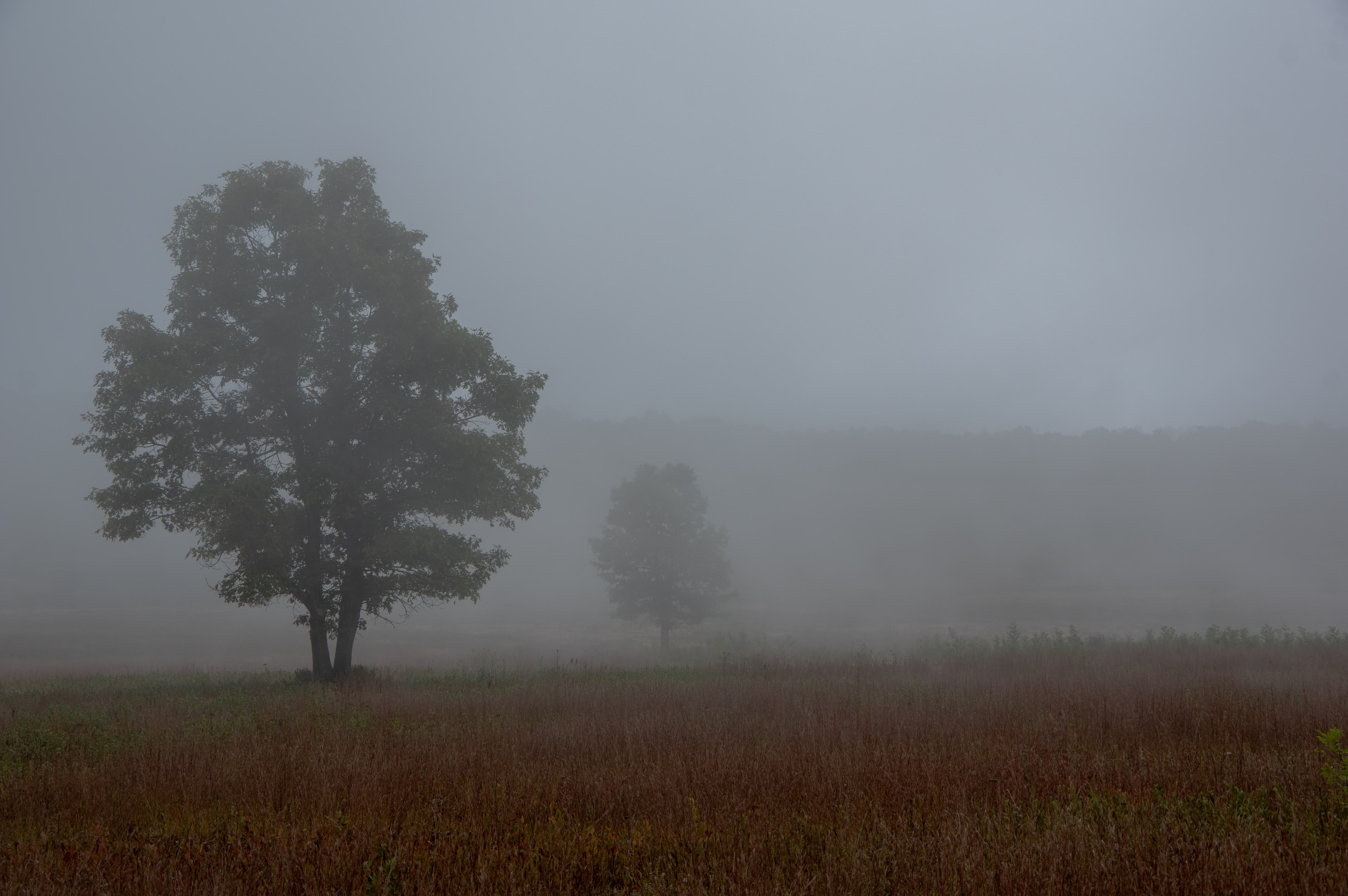
And for now, enjoy this photo of a beautiful view from one of the local breweries here in my corner little of Virginia. We spent some time in the countryside yesterday and it was just lovely. If it’s going to be spring in winter, might as well enjoy it, right?
I’m thankful for the wild things. The dew that slicks the blades of grass, the bee at his work, the birds who fill the air with song, the kits in their den dreaming of play and the deer in the meadow bathed in snow – outside my door, a whole world turns not in days and hours, but in moments, seasons and sensations. In the changing of the leaves, the rising and setting sun, these little lives go on and on until they don’t, and then, like a breath between words, they’re gone. How much we could learn from the brave, wild things, if we’d only each take time to wait and watch, to sit patiently with the silence before the storm, the crickets’ evening concerto, the breeze through the fields, the morning’s cacophony. They exist, not for us to see as a space apart, but with us, in us. We, too, could be brave, wild things. We know it in our hearts.
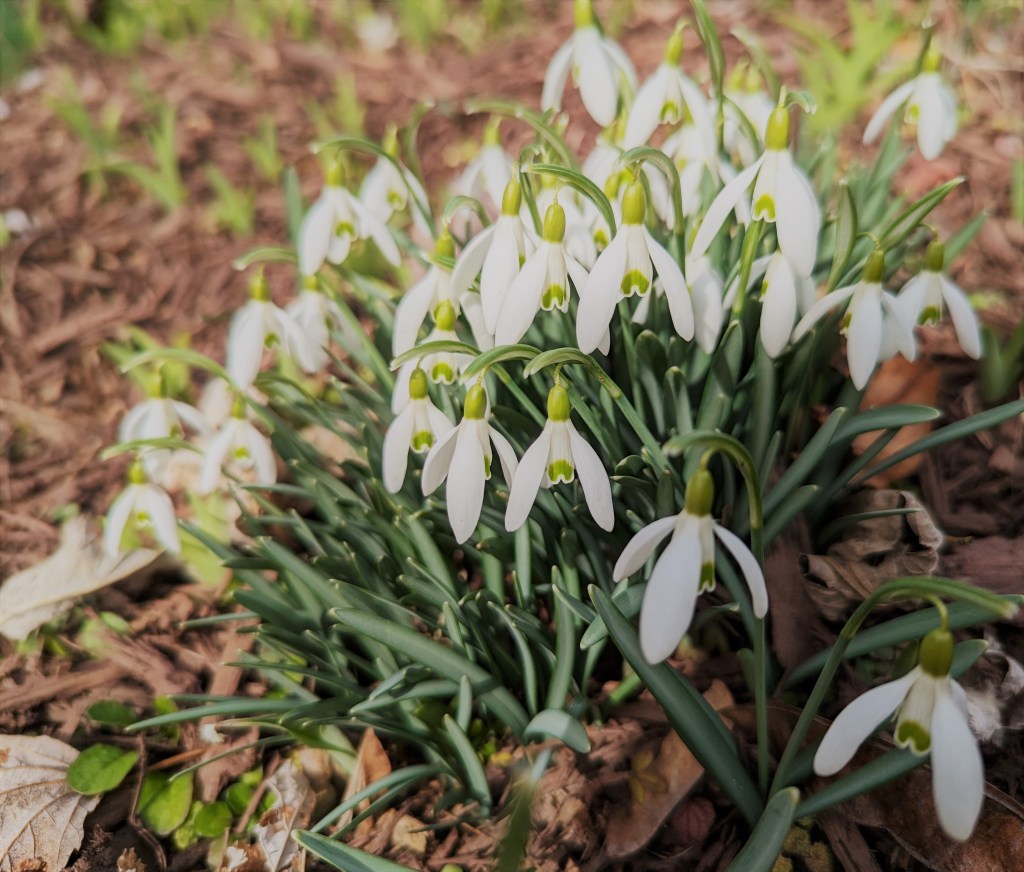
Well, it seems this is it: The closest I’ll get this winter to seeing snow. So, hello little lovely. I truly am glad you’re here, though I wish more for your namesake at this point in the year. Still, I suppose, you’re no less dear to the season. And I know, at the end of the day, a fall or a flower is just no choice of mine to make.
I’ve written a few love poems, but this one’s just for you: Valentine, glad you’re mine, grateful for our time together. See, I’m not so good at love poems, am I? Though, whether or not that’s true, it doesn’t matter. I could write thousands of words, send them out into the universe, make them new every day, spin them out of threads and star stuff, and build a million little love stories infinite webs and lines and paths just for us. And it still wouldn’t be enough to show you how much I love you.
It’s been a while since I participated in one of Rebecca’s poetry challenges over at Fake Flamenco, and I’m excited to get back to it. This month’s challenge is to write a tanka poem about a friend or companion animal. And you know how I feel about friendship. 😊 So here are my contributions, because it seems like I can never write just one.
Today, I called you just to say hello and chat about life and stuff. It was a small moment, but those small moments make a life.
Wherever we go together, that’s home for me. Home isn’t a place, see, because instead it’s love that makes a home in our hearts.
If you’d like to participate, as well, you’ve got until Sunday, February 5th. I think you should! I always enjoy these, and reading everyone’s poems is definitely the best part.
The first letter arrived with the new year. In an unmarked, tattered envelope, typed on clean white paper, it read simply: “Come to the woods.” The second, two weeks later, added: “Full moon, 8:30.”
“Kids,” my father said, and tucked both letters as far into the trash can as he could get them.
We’d moved to the new neighborhood in December, just my dad and me in our old truck, packed with the paltry amount of worldly things we actually owned and all of our hopes and dreams for this new life.
“I’m a kid,” I told him.
“Sure,” he said. “But you have the common sense not to go running around in the dark in the middle of winter.”
He had a point, though it wasn’t common sense that kept me indoors and out of the night. It was fear. My shameful secret, that at fourteen and perfectly capable of knowing better, I was afraid of the dark. Dad didn’t need to know that.
“When is the full moon?” I asked.
“Three days from now,” he said. “Not that it matters.”
“It’s supposed to snow three days from now,” I said. “At least half a foot.”
“Common sense,” Dad said. “Foolishness, out in the dark in the snow.”
Our new neighborhood was surrounded by a thick circle of woods, which the realtor said meant that it would be nice and private, and which I found more claustrophobic and unsettling than nice. Our old neighborhood in the city had no woods. It did have traffic, and noise, and old Mrs. Devlin and her cats. I didn’t much miss Mrs. Devlin, but I did miss the cats. And the noise.
“You’ve done your homework?” Dad asked me, and pulled me out of my memories.
“Yes,” I answered. “And tomorrow’s reading, too.”
“Good girl,” he said. “I’ll get started on dinner. Why don’t you go and do something fun.”
I raised an eyebrow.
“You’ve earned it. All this unpacking. Go take a nap or something. Go call your friends.”
I didn’t really have any friends. Dad didn’t need to know that, either. He would worry. So I just said, “Okay,” and walked up the stairs to my room.
The new house wasn’t quite new. New to us, sure, but the wood-paneled walls and green bathroom tiles gave it away.
“It’s like the Brady Bunch,” I’d told Dad, when we’d first found the listing.
“That a bad thing?”
“I like it,” I’d said.
And I did. It felt homey, lived in, like it had a story.
“You’d love it, Mom,” I said to a small, framed photo on my bedside table.
My mom had died six months ago, and I still told her everything. We’d sold most of our stuff to pay for her treatments, even after insurance, something she told me I shouldn’t have to understand at this age. But you’re never the right age to lose a parent. I think she knew that, too. But Dad and I were okay. We were doing okay, in spite of everything. He’d even learned to cook. Mostly casseroles, but I wasn’t complaining. Neither of us particularly enjoyed time in the kitchen.
“We’ve been getting these weird letters,” I said to Mom. “What would you do?”
I could hear Dad banging around in the pots and pans, looking for his favorite baking dish.
“Yeah,” I told Mom. “Dad has one of those now, a favorite baking dish. Anyway, what would you do? Would you go to the woods?”
Silence.
“I don’t really think it’s a good idea, either. But you know me.”
More silence.
“You did always call me Curious Kelly.”
The next evening, two days before the full moon, we found another letter in the mailbox. “Don’t be afraid,” it read.
“Yeah, right,” Dad said as he handed it over to me. “Not scary at all, random letters from a stranger telling you to come to the woods.”
“Murder probably but not entirely guaranteed,” I said.
But my mind was made up, not that Dad needed to know that, either. I figured, this was a safe neighborhood, and we’d made sure of it before we bought the house. Safe and quiet, except the fox screams, which we’d been told were totally normal for this area. How very bad could it be, whatever it was we were meant to find in the woods? I talked to a dead woman on a regular basis, right? I already lived in “weird kid” territory.
And besides, I thought, fourteen is too old to be afraid of the dark. Way, way too old.
So, that was how I came to find myself, two days later, venturing into the deep, wild woods in the tawny glow of the evening, with snow on the way. I’d packed a backpack full of what I thought were essential supplies: a flashlight, a whistle, a book of matches, gloves, scarf, hat, extra coat, water, and most importantly, Mom. Well, her picture anyway. I found my way in easily enough, since the woods edged up to my own back yard.
How funny would that be, I thought, as I crunched over fallen leaves and balanced across downed limbs and vines. I could see the headline now: “Local Girl, New to Area, Disappears from Own Back Yard.” Best not to think too hard about that, I reminded myself. Bad enough to be out alone in the growing darkness.
And oh, God, the darkness.
There’d been plenty of light when I left the house, but out here, under the trees, it was like a canopy of gray-black, like the branches absorbed everything, like they left nothing for scared, pathetic teenage girls probably doing the wrong, stupid thing anyway.
I took a deep breath and closed my eyes. In and out, in and out. I focused just on me, on getting air into my lungs. I counted – five, four, three, two, one, one, two, three, four, five – and opened my eyes again. Bad idea.
I could swear I saw, well, I don’t know. And from my right side, I heard a scream. Just a fox, I was sure. Only a fox. But then, from my left side, I heard a sharp crack, a grunt, the sound of something scampering in the underbrush.
“Nope,” I said out loud. To Mom? Probably just to myself. “Nope, nope.”
And I turned, started to run, and promptly fell on my face.
“It’s like a scene from a horror movie,” I said.
The wind rustled through the empty tree limbs, a dry, sandy whisper.
“Okay,” I said. “Okay, now I know I hate the woods.”
A crow cawed, an owl screeched. I didn’t even know I knew what those sounded like.
I pushed myself upright, sat on the forest floor and pulled my knees to my chest. I tugged my backpack around and grabbed my flashlight. I clicked it on, checked the time on my watch. Only 7:45.
“I am such an idiot,” I added.
I could feel the dark, like a living, breathing, slouching, slogging monster, creeping up behind me, all around me. An angry dark. A lonely dark. A hungry dark.
I breathed in and out again, hoisted myself up. And I ran. As fast as you can run in the woods, anyway, I ran, all the way back to the house this time. I didn’t look back once. If this was a prank, some mean joke to haze the new kid, if someone really was in the woods waiting for me, or for Dad, or for whatever moron decided to actually go there in the middle of the night, I felt perfectly fine never, ever knowing the real truth. This mystery, as far as I, frightened, out of breath, and questioning every choice that had led me to this moment, was concerned, could remain a mystery forever.
Dad asked where I’d been, once I came through the door.
“Library,” I answered. I think that was the first, and last, time I ever lied to my father.
“Good thing you got home,” he said. “Starting to snow.”
It was, and I hadn’t even noticed.
The next morning, we awoke to a world awash in light, bright and twinkling. Snow covered the ground, the trees, the truck. Half a foot had become a foot and a half overnight.
“Bet you won’t have school today,” Dad said, and he was right.
We spent the day together, since he certainly couldn’t get to work, playing board games and watching bad daytime TV. We made a fire in the fireplace, our first ever, since our old place didn’t have a fireplace. We made lasagna for dinner, also our first ever. And for dessert, we shared a pint of ice cream on the couch. I’d say it was the happiest we’d been since Mom.
“This is nice,” I said.
“Love you, too, kiddo,” Dad answered.
At about 7:00, I checked the mail. We’d forgotten earlier in the day, and honestly, we thought it wouldn’t even run. And maybe it hadn’t, because the only thing in the mailbox was a tattered envelope. I opened it, outside, where Dad couldn’t see. It said: “The woods are waiting.”
I tore both the envelope and letter into pieces, small as I could rip them, stuffed the pieces into my coat pocket, and went back inside.
************
Thank you for reading! This is the first of twelve stories I’ll write for my 2023 Short Story Challenge. The theme this year is: Wild.
I hope you join me and write some stories of your own this year! It’s fun, and I hope this will be a happy year full of good stories. But just reading is fine, too, and I’m glad you’re here.
The next story will be posted at the end of February.
Over the race and into the woods, just down the forest path – there we’ll go. In search of adventure, in search of snow, we’ll step and turn and twirl and dance. We’ll take this chance. And if, along the way, we find a journey or a day, we’ll know – we were meant to be here in this winter wonderland. Will you join us? Then take my hand.
I’m not that fond of summer. I’m quite okay with spring. Fall is a time for magic, and winter is my scene. But as I sit here waiting, as far as winters go, I think this one’s been boring because we’ve had NO SNOW!
Okay, but seriously, it’s looking like we’ll see no snow at all this winter. I can’t lie – I’m really disappointed. We’ve had some very cold weather, and then some relatively warm weather, winter-wise, and we’ve had some rain, and some fog, oddly enough, but absolutely zero snow. I know this happens some years. It’s fine. Maybe it means next year’s winter will be extra beautiful.
In the meantime, at least there’s tea. And books. And fuzzy blankets. And various other cozy winter things.




 A Virginia Writer's Diary